
How Much Does It Cost to Build an AI Application in 2026?

Two founders. Same request: "We want to add AI to our product." One gets a quote for $18,000. The other gets a quote for $340,000. Both are for "an AI application."
The gap isn't a scam — it's a scope problem. AI projects have more cost variables than traditional software development, and most founders don't know which questions to ask before they get a quote. The result is either sticker shock or a dangerously under-scoped project that blows up in production.
This guide gives you real numbers, a framework for understanding what drives cost, and the questions to ask before you sign anything.
The 4 variables that actually drive cost
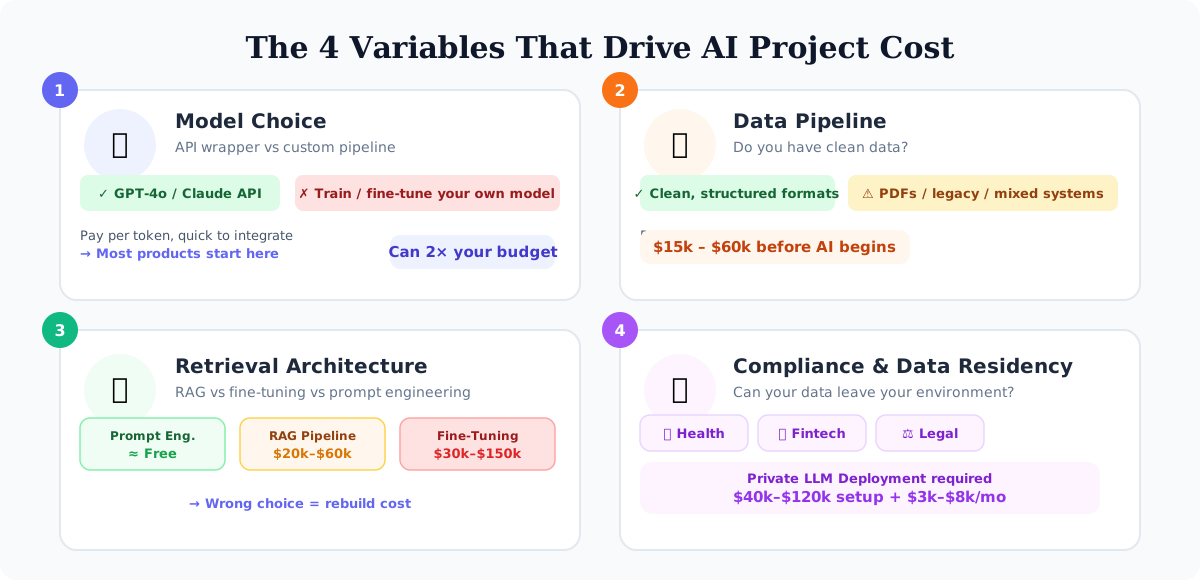
Unlike traditional software where the main cost drivers are team size and feature count, AI projects have four distinct variables that can independently double or halve your budget.
1. Model choice: API wrapper vs custom pipeline. The cheapest path is calling an existing model via API — OpenAI's GPT-4o, Anthropic's Claude, Google's Gemini. You pay per token, the model is maintained by someone else, and your engineers focus on the integration layer. This is what most AI features start as. The expensive path is training or fine-tuning your own model — you need GPUs, data science expertise, and an ongoing training budget. Most products don't need this, and the ones that do often discover it after they've already shipped an API-based MVP.
2. Data pipeline: Do you have clean data? An AI application is only as good as the data it runs on. If your documents, transcripts, or records are already in a clean, structured format, the integration is straightforward. If they're in scanned PDFs, legacy databases, mixed formats, or across disconnected systems, you need a data engineering phase before the AI work even begins. This phase alone can cost $15,000–$60,000 depending on volume and complexity.
3. Retrieval architecture: RAG vs fine-tuning vs prompt engineering. How your AI application accesses and uses your specific data is a significant architectural decision. A simple prompt-engineering approach (write better system prompts) might be free. A RAG (retrieval-augmented generation) pipeline that searches your document library costs $20,000–$60,000 to build properly. Fine-tuning a model on your proprietary data costs $30,000–$150,000 and requires ongoing retraining budget. The right choice depends on your use case — many teams pick the wrong one and pay to rebuild.
4. Compliance and data residency. If your application handles sensitive data — patient records, financial documents, legal contracts — you may not be able to send it to a third-party model API at all. Private LLM deployment (running a model inside your own cloud environment) costs $40,000–$120,000 to set up and adds $3,000–$8,000/month in infrastructure. Healthcare, fintech, and legal applications routinely need this.
Real price ranges by project type
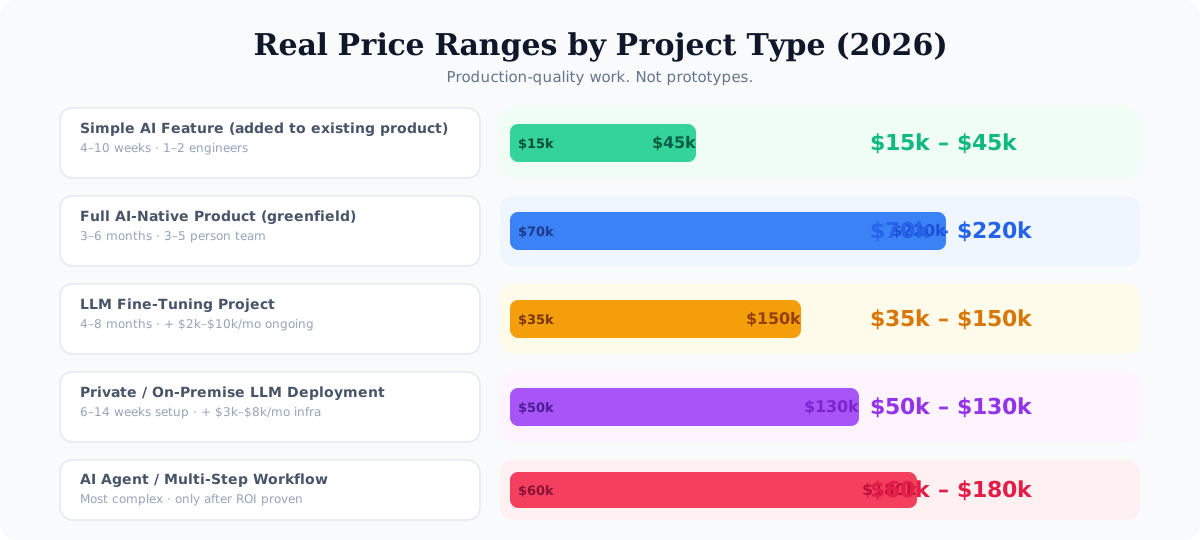
These are market rates as of 2026 for production-quality work — not prototypes, not proof-of-concepts that break at scale.
Simple AI feature added to an existing product
$15,000–$45,000
What this buys: a single AI-powered capability wired into your existing application. Examples: an AI summary on a dashboard, a smart search bar that understands natural language, a document classification feature, an auto-draft email reply. Uses an existing model API, limited data pipeline work, minimal compliance overhead. Timeline: 4–10 weeks.
Full AI-native product (greenfield)
$70,000–$220,000
What this buys: a standalone AI application built from scratch — an AI copilot for a vertical workflow, an intelligent document processing system, a conversational product that handles multi-turn interactions. Includes proper prompt engineering, a retrieval layer, a feedback loop, monitoring, and fallback handling. Timeline: 3–6 months with a team of 3–5.
LLM fine-tuning project
$35,000–$150,000 (plus $2,000–$10,000/month ongoing)
What this buys: a model tuned on your proprietary data to produce outputs that match your specific domain, tone, or task. Requires significant data preparation work, GPU compute, and evaluation infrastructure. Most teams discover they don't need fine-tuning after building an MVP with RAG — start there first.
Private / on-premise LLM deployment
$50,000–$130,000 (setup) + $3,000–$8,000/month (infrastructure)
What this buys: a model running entirely within your cloud account or on-premise servers, with no data leaving your environment. Required for most regulated industries. Uses open-source models (Llama, Mistral) or licensed enterprise models. Timeline: 6–14 weeks to first deployment.
AI agent or multi-step workflow
$60,000–$180,000
What this buys: an autonomous agent that takes actions — browsing, writing, calling APIs, making decisions — rather than just generating text. Significantly more complex than a chatbot or summary feature because you're now handling failure modes, retries, approval flows, and audit logs. Only worth the cost once simpler AI features have proven ROI.
If your project involves building AI into a larger software product, the AI components add to — not replace — the base software cost. See our custom software development cost guide for the non-AI portion of the estimate.
What a quote should include (and what's often left out)
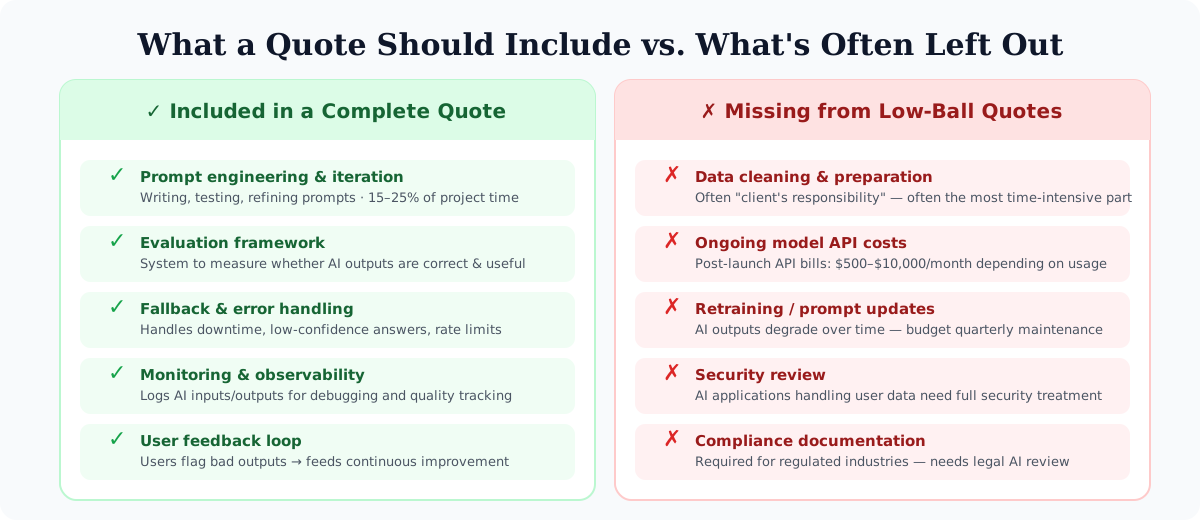
The cheapest AI quotes almost always leave out the same things. Here's what a complete, production-ready AI project scope covers — and what to watch for when it's missing.
Included in a complete quote: Prompt engineering and iteration — writing, testing, and refining the prompts that control model behaviour, which accounts for 15–25% of AI project time. Evaluation framework — a system for measuring whether the AI is producing correct, useful outputs; without this, you won't know when it breaks. Fallback and error handling — what happens when the model is unavailable, returns a low-confidence answer, or hits rate limits. Monitoring and observability — logging AI inputs and outputs so you can debug issues and track quality over time. User feedback loop — a mechanism for users to flag bad outputs, which feeds improvement cycles.
Commonly missing from low-ball quotes: Data cleaning and preparation — often treated as the "client's responsibility" even when it's the most time-intensive part of the project. Ongoing model costs — the API bill after launch can be $500–$10,000/month depending on usage. Retraining or prompt updates — AI outputs degrade as the world changes; budget for quarterly maintenance. Security review — AI applications that process user data need the same security treatment as any data-handling system. Compliance documentation — required for regulated industries, often requiring a legal review of the AI's decision-making process.
Red flags and green flags in an AI development quote
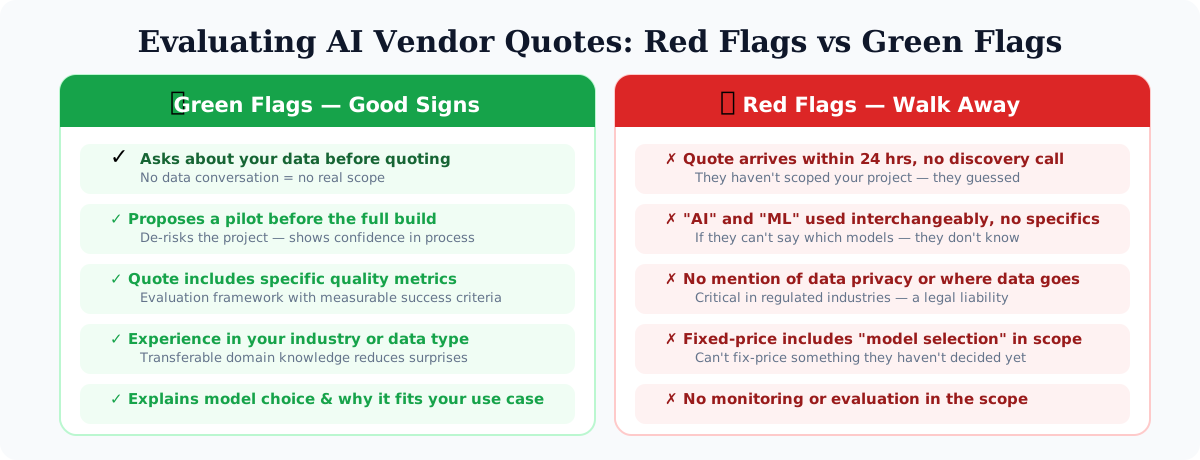
Evaluating AI vendor quotes is harder than evaluating traditional software quotes because the technology moves fast and most buyers don't have the background to spot a weak proposal.
Green flags: The vendor asks about your data before quoting. They propose starting with a proof-of-concept or pilot before the full build. The quote includes an evaluation framework with specific quality metrics. They've built something in your industry or with similar data types before. They can explain the model choice and why it fits your use case.
Red flags: A quote arrives within 24 hours of your first conversation without a technical discovery call. The proposal uses "AI" and "machine learning" interchangeably without specifics about which models or techniques. There's no mention of data privacy or where your data goes during processing. The quote is fixed-price for a scope that includes "AI model selection" — this signals they haven't done discovery yet. There's no monitoring or evaluation component in the scope.
If you're building in a regulated industry — healthcare, fintech, legal — ask explicitly where your data goes during inference, who has access to it, and what the vendor's data retention policy is. If they don't have a clear, written answer, they're not the right partner.
Our AI application development team has built production AI systems including Kuyil AI. For teams that need dedicated AI engineers placed quickly, our staff augmentation model places AI-specialist engineers in 14 days.
Frequently asked questions
Can I build an AI application for under $10,000?
A proof-of-concept or internal tool, yes. A production application with proper error handling, monitoring, and user-facing reliability, no. The most common version of this mistake: a founder builds a $5,000 demo, shows it to customers, gets positive feedback, then discovers the production version costs $60,000 to build properly. Build the MVP right the first time.
How much does the OpenAI or Anthropic API cost to run?
Highly variable. A low-traffic internal tool might cost $50–$200/month. A customer-facing product processing thousands of documents per day can cost $5,000–$20,000/month. Get a usage estimate from your vendor before launch — most don't volunteer this number.
Should I use GPT-4o, Claude, or an open-source model?
For most products, start with a frontier API model (GPT-4o or Claude Sonnet) because they're fast to integrate and have the broadest capability. Switch to open-source (Llama, Mistral) if you need data residency, if usage costs become prohibitive, or if you need a capability the frontier models don't offer. The switch is possible but costs 4–8 weeks of re-engineering.
How long does it take to build an AI product?
A simple AI feature: 4–10 weeks. A full AI product: 3–6 months. A fine-tuned model with custom infrastructure: 4–8 months. These timelines assume the team has done this before. First-time AI projects routinely run 40–60% over initial estimates because of data problems, model behaviour surprises, and evaluation gaps that weren't scoped.
What's the biggest mistake teams make when building AI products?
Skipping evaluation. Most teams build the AI feature, do some informal testing, and ship it. Then outputs degrade, edge cases break, and they have no system for catching or fixing it. Build your evaluation framework before you build the feature — it's the difference between an AI product and an AI experiment.
Ready to get a real number for your AI project? See how our AI application development process works, then book a free 15-minute call with Srijith — no pitch, just a straight conversation about your data, your use case, and what it would actually cost to build it right. Book your call here.