
How Much Does Custom Software Development Cost in 2026?

Every founder who's shopped around for a software development partner has hit the same wall: you fill out a contact form, describe your project, and get back a response that says "great, let's hop on a call to discuss scope." No numbers. No ranges. Not even a ballpark.
This is frustrating for a reason. Pricing transparency is a trust signal, and the agencies that hide behind "it depends" are often the ones that hit you with a surprise invoice in month three.
This guide gives you real numbers. Not exact quotes — those genuinely do depend on your specific requirements — but realistic ranges you can use to budget, compare proposals, and spot when you're being over- or undercharged.
The three pricing models for custom software
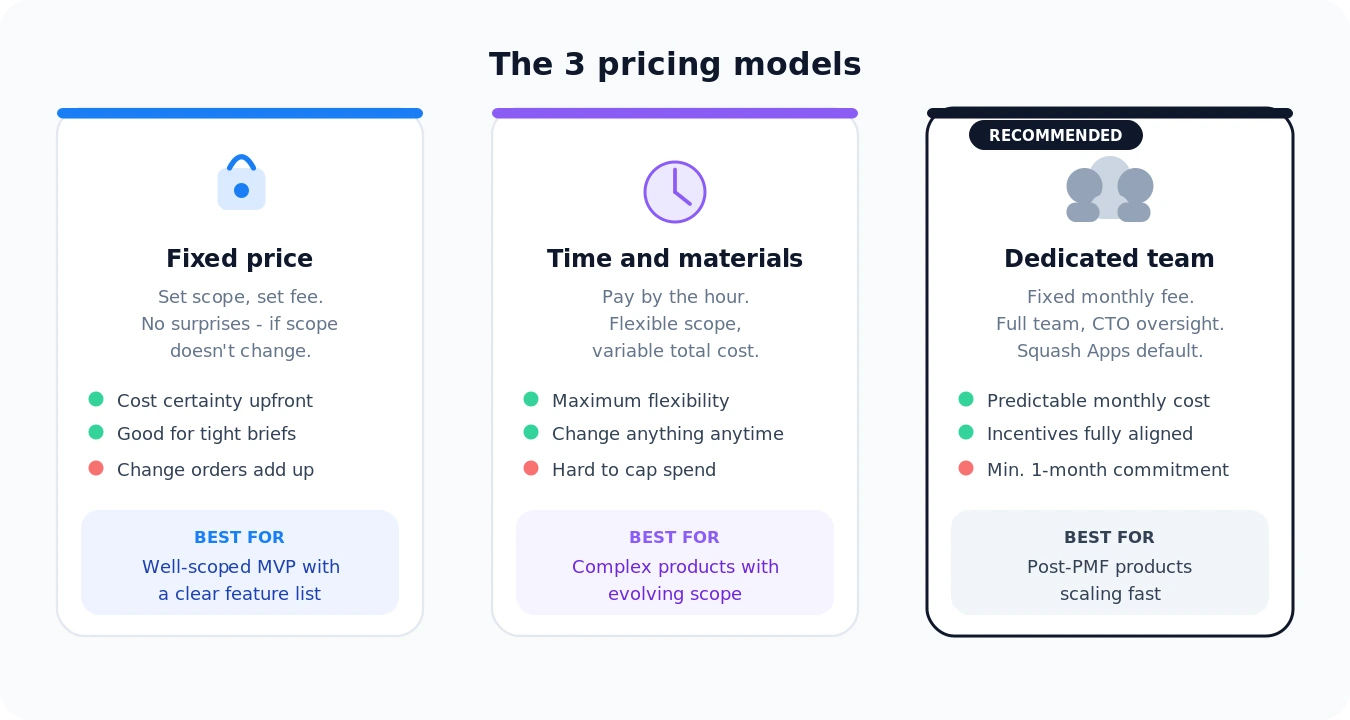
Before you get to numbers, you need to understand how agencies structure their fees. There are three models, and the right one depends on how well-defined your project is.
Fixed price. You pay a set amount for a defined scope. The agency builds exactly what's in the spec, you pay the agreed fee, and the project closes. Works well when you know precisely what you want — a well-scoped MVP with a clear feature list, for example. The risk: scope is never as fixed as it looks on paper. Any change — a new user role, a different API, a revised onboarding flow — typically triggers a change order and additional cost. Fixed-price projects routinely come in 20–40% over the quoted amount.
Time & Materials (T&M). You pay a daily or hourly rate for the team working on your project. Flexible — you can add or remove features as the build progresses. The risk is unlimited spend if the engagement isn't tightly managed. T&M without a strong project manager on your side is how projects quietly double in cost.
Dedicated team retainer. You contract a team — typically an engineer or two, a PM, and QA — for a fixed monthly fee. The team is yours for the month. You direct the sprint, own the backlog, and pay the same amount whether you had a productive month or a slow one. This is the model Squash Apps recommends for most ongoing product development because the incentives are aligned: the agency has no reason to manufacture scope, and you have a predictable monthly line item.
Real cost ranges by project type
These ranges are based on market rates as of 2026 for teams that include a project manager, at least one senior engineer, and QA — not just a freelancer with a laptop.
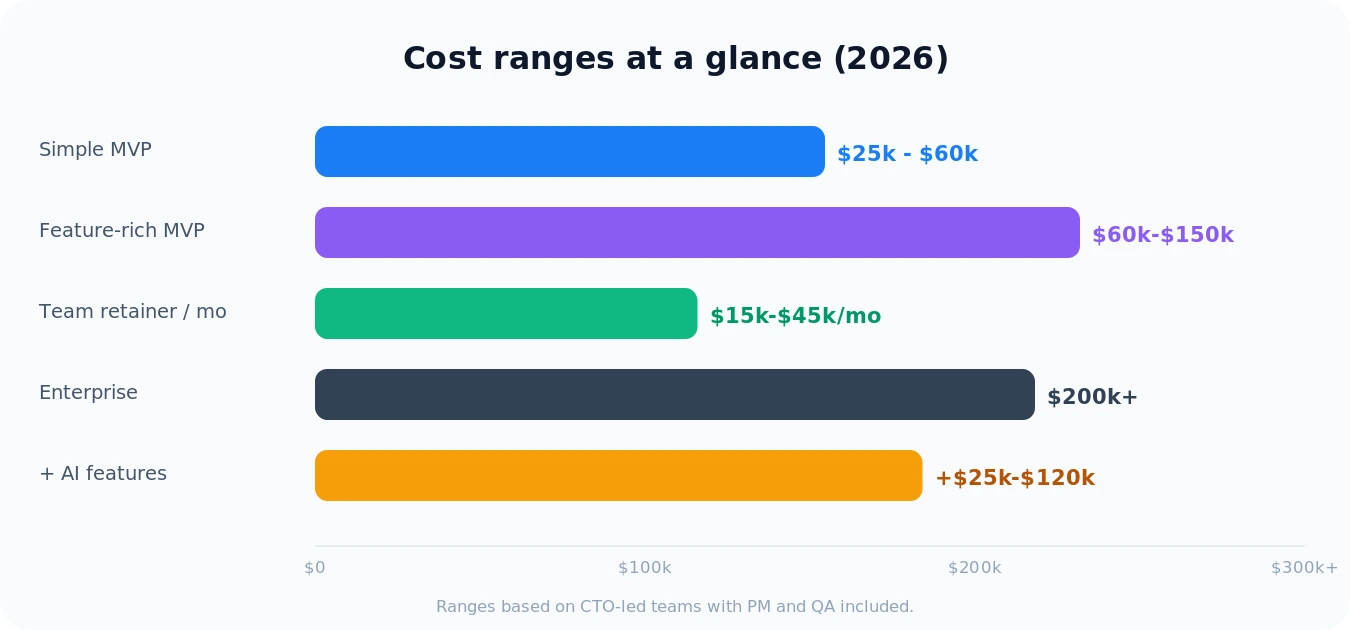
Simple MVP (2–3 engineers, 8–14 weeks)
$25,000–$60,000
What this buys: a working product with core features, one user role, basic auth, and a handful of integrations (typically payments and email). Think: a marketplace with buyer/seller flows, a SaaS with a single primary workflow, or a booking platform. This is not a polished product — it's a functional one you can put in front of early customers.
Feature-rich MVP or V1 product (3–5 engineers, 3–6 months)
$60,000–$150,000
What this buys: multiple user roles, a full admin dashboard, mobile-responsive or native mobile, multiple third-party integrations, and enough polish that you'd be comfortable showing it to investors. The wide range here is driven almost entirely by the number of integrations and how complex the data model is.
Production SaaS or scaling an existing product (4–8 engineers, ongoing)
$15,000–$45,000/month on a dedicated team retainer
What this buys: a full cross-functional pod — senior full-stack engineers, a PM, QA, and CTO-level architecture oversight. This is the right model once you've validated product-market fit and need to move fast. Monthly cost scales with team size and seniority mix.
Enterprise software (custom ERP, platform integrations, regulated industries)
$200,000–$1,000,000+
What this buys: complex integrations with legacy systems, compliance work (HIPAA, SOC 2, PCI), multi-tenant architecture, detailed security auditing, and stakeholder management across multiple business units. Enterprise projects almost always run on T&M or a dedicated team model — fixed price doesn't work at this scale.
AI-integrated product (add to any of the above)
+$25,000–$120,000
If your product includes LLM features — a copilot, document intelligence, RAG-based search, or an AI workflow — budget an additional $25k–$120k depending on whether you're wrapping an API (cheaper, faster) or building a custom model pipeline (more expensive, more control). See our AI application development services page for a breakdown of what drives cost in AI projects specifically.
What drives the cost up (or down)
Two projects described as "an MVP" can differ by $100,000 in cost. Here's what accounts for the gap:
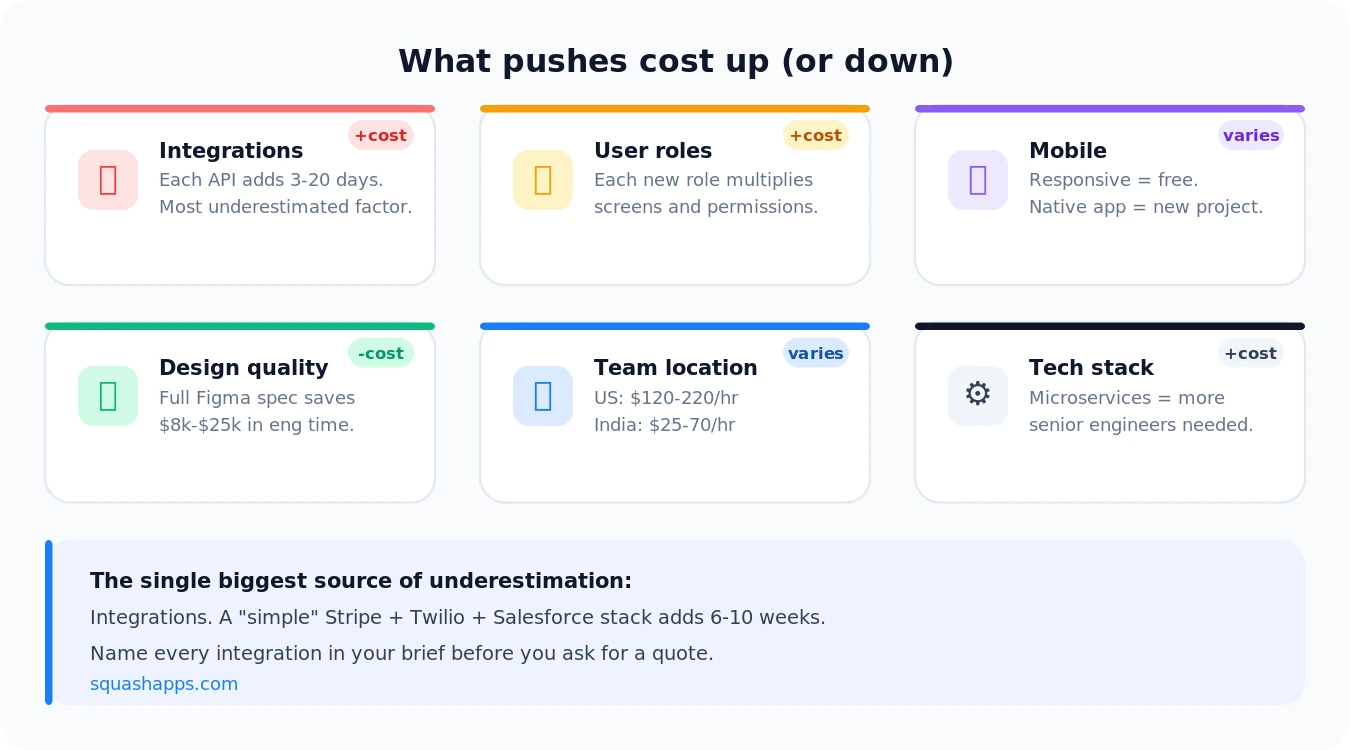
Number of integrations. Every third-party service you connect — Stripe, Twilio, Salesforce, a logistics API, a government data feed — adds development time. A single clean API integration might take 3–5 days. A poorly documented one with edge cases can take 3–4 weeks. This is the single biggest source of underestimation.
User roles and permissions. One user type with one flow is simple. Add an admin panel, a vendor role, a reviewer role, and a super-admin, and you've potentially multiplied scope by three or four. Map out every user type before you get a quote.
Mobile. Responsive web is cheap — it's included. A native iOS or Android app is a separate project. A React Native app that shares logic with your web backend is in between. Be explicit about what "mobile" means in your brief.
Design requirements. Working from a complete Figma spec cuts engineering time significantly. Working from a sketch on a napkin adds a UX/UI phase that can run $8,000–$25,000 on top of the build cost.
Team location. US-based engineers: $120–$220/hour. UK/Western Europe: $80–$150/hour. India/Southeast Asia: $25–$70/hour. Squash Apps operates on a CTO-led pod model from Coimbatore, India with senior engineers at the top end of the India range — typically $40–$65/hour depending on seniority. The pricing reflects 10+ years of experience, not entry-level rates.
Tech stack complexity. A Next.js + PostgreSQL + Stripe stack is fast to build and easy to hire for. A microservices architecture with Kafka, Kubernetes, and multiple databases takes longer to build and requires more senior engineers. Match the stack to your actual needs, not what sounds impressive.
Hidden costs most buyers forget to budget for
The build cost is only part of what you'll spend in year one.
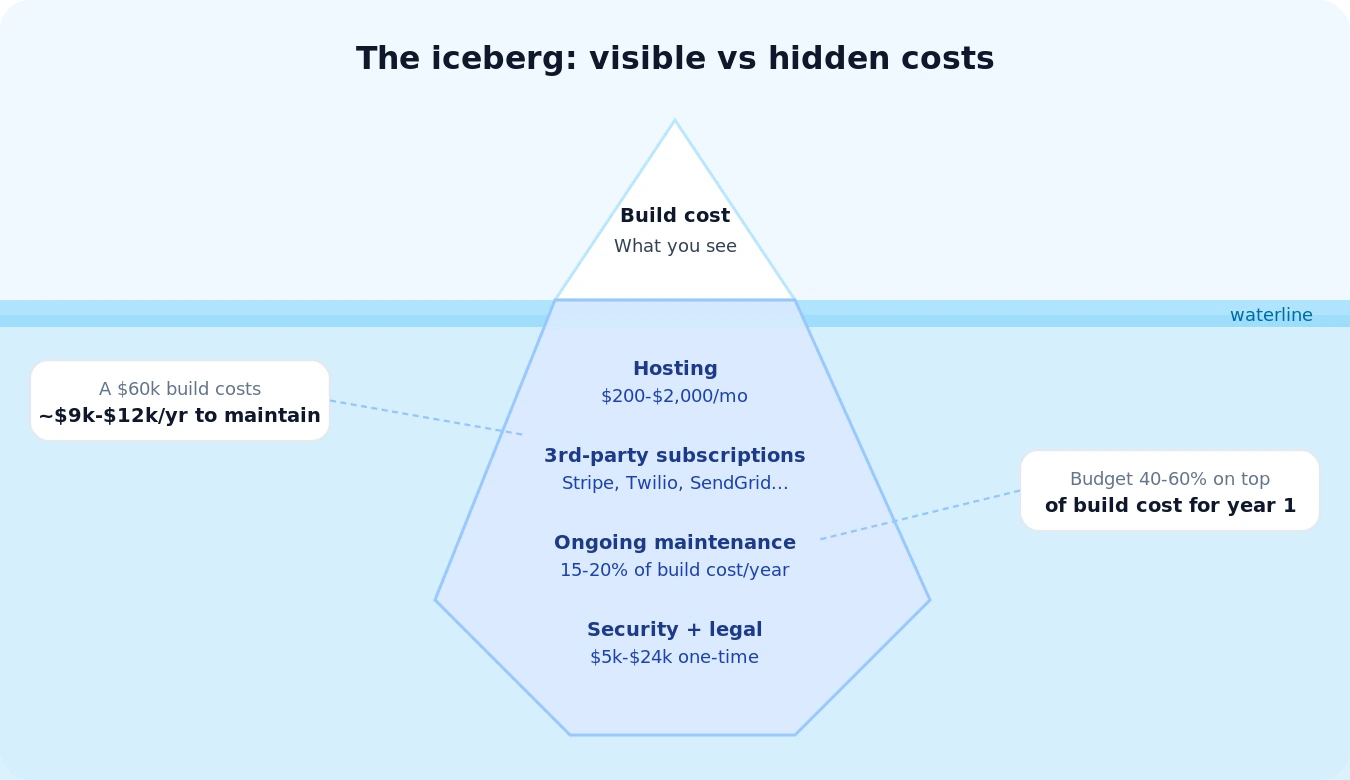
Hosting and infrastructure. Budget $200–$2,000/month depending on traffic and architecture. A small MVP on AWS or Azure: $200–$400/month. A production SaaS with proper redundancy, CDN, and database backups: $800–$2,000/month.
Third-party service subscriptions. Stripe (2.9% + $0.30 per transaction), Twilio (usage-based), SendGrid, Intercom, Segment — these add up. Run through your integration list and calculate the monthly cost at your projected usage before you launch.
Ongoing maintenance. Rule of thumb: budget 15–20% of the build cost per year for maintenance — bug fixes, dependency updates, minor feature work, and keeping the app compatible with OS/browser updates. A $60,000 build costs roughly $9,000–$12,000/year to maintain at a baseline level.
Security. If you handle sensitive data, budget $5,000–$20,000 for a security audit before you go to production. Non-negotiable for healthtech, fintech, and any product that stores PII.
Legal. Privacy policy, terms of service, and data processing agreements if you have EU users: $1,500–$4,000 with a tech lawyer. Don't copy-paste from another site — it creates liability.
How to get an accurate quote
The quality of the quote you receive is directly proportional to the quality of the brief you provide. Here's what to include:
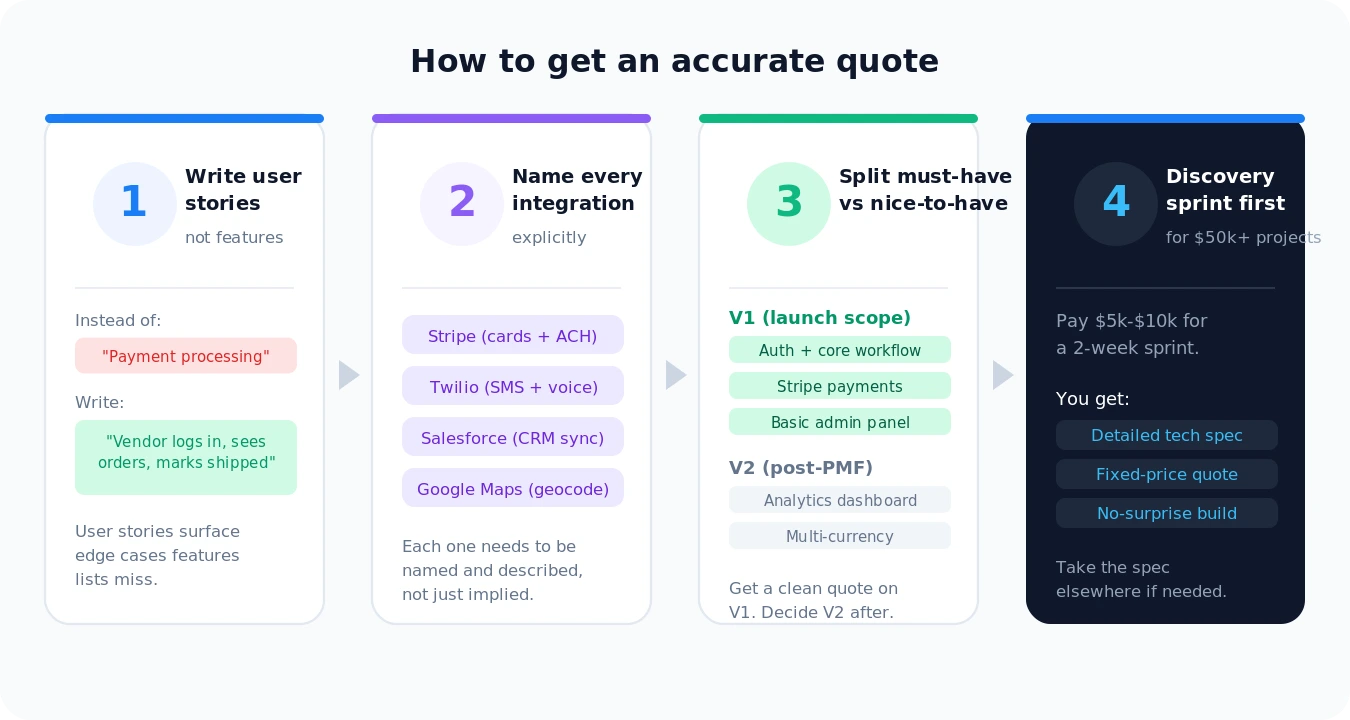
Write user stories, not features. "User can log in" is a feature. "As a vendor, I can log in with Google, see my open orders, and mark them as shipped" is a user story. User stories force you to think through the actual workflow, which surfaces edge cases that features lists miss.
List every integration explicitly. Don't say "payment processing" — say "Stripe, supporting cards, Apple Pay, and ACH transfers, with webhook handling for payment failures." Every integration needs to be named and described.
Separate must-haves from nice-to-haves. Give the agency a V1 scope (what you need to launch) and a V2 scope (what you'd add if you had more budget). This lets them quote the core project cleanly, and you can make a rational decision about what to cut.
Ask for a discovery sprint first. If you're spending more than $50,000, it's worth paying $5,000–$10,000 for a 2-week discovery sprint before the full project starts. The agency does a proper technical scoping, produces a detailed spec, and gives you a fixed-price quote for the build phase. You get a real number instead of a guess, and you can take that spec elsewhere if you choose not to continue.
Our staff augmentation model is often the right fit for teams that already have a technical lead internally and need senior engineers to execute — you get the people without the project management overhead.
Frequently asked questions
Can I build a custom software product for under $10,000?
Rarely, if you're working with a professional team and need a production-quality product. At under $10,000 you're looking at a very simple tool — a single-user app with no integrations — or you're working with junior freelancers, which comes with its own risk profile. A no-code tool like Bubble or Webflow is often a better starting point at that budget.
Why do quotes from different agencies vary so much?
Three reasons: team location (rates vary 4x between US and India), team seniority (a senior engineer is 2–3x faster than a junior), and how much the agency understood your brief. If one quote is 50% cheaper than the others, ask what's different — it's almost always team composition or an assumption that something is out of scope.
Should I choose fixed price or T&M?
Fixed price if your spec is locked and you want cost certainty. T&M or a dedicated team if your product is evolving or you expect the scope to change. Most products are better served by a dedicated team model once they're past the initial MVP stage.
How do I know if a quote is reasonable?
Divide the total cost by the number of weeks and by the team size implied in the quote. If the implied daily rate per engineer is below $300, you're probably looking at junior engineers. If it's above $1,200 for an offshore team, ask what justifies the premium. The sweet spot for a senior engineer in India on a well-managed team is $400–$700/day all-in.
Does Squash Apps do fixed-price projects?
Yes, for well-scoped MVPs where we've done a discovery sprint first. For anything evolving or ongoing, we recommend our dedicated team model — it's more predictable for both sides and produces better outcomes because the team isn't incentivised to pad scope.
Ready to get a real number for your project? See how our custom software development process works, then book a free 15-minute call with Srijith to walk through your requirements — no sales deck, no pitch, just a straight conversation about what you're building and what it would cost. Book your call here.