
How Much Does It Cost to Hire a Dedicated Development Team in 2026?

Before the first call, every founder asks the same question. Not "what can you build?" or "how do you work?" — it's "how much does a dedicated development team cost?" Which is entirely reasonable. Budget shapes everything: team size, seniority level, engagement model, and whether this is even the right approach for your stage.
The honest answer is: it depends on four things. And once you understand those four things, you can build a budget with real numbers in under 10 minutes.
Dedicated team vs staff augmentation vs project outsource
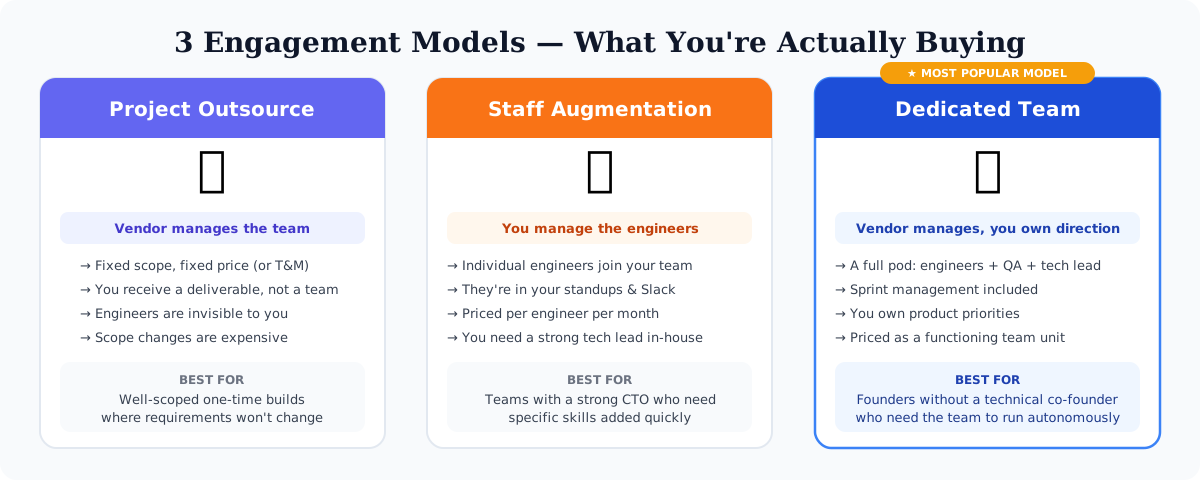
These three terms are used interchangeably online. They mean different things in practice.
Project outsource is a fixed-price or time-and-materials contract for a defined deliverable. You specify what you want, a vendor builds it, you pay on delivery. The team is the vendor's problem — you don't see them and you don't manage them. Best for well-scoped, one-time builds where you won't need ongoing changes.
Staff augmentation is renting individual engineers who work inside your existing team. You manage them directly — they join your standups, your Slack, your Jira. The vendor handles payroll and HR. Best for teams that have a strong technical lead and need to add specific skills quickly.
Dedicated development team is the hybrid: a fully composed engineering pod — senior engineers, QA, sometimes a tech lead and DevOps — that operates as an extension of your company but is managed by the vendor. You own the product direction; they own the delivery. Best for founders who don't have an in-house engineering manager and need the team to run autonomously at a high level.
The cost structures are different too. Staff augmentation is priced per engineer per month. Dedicated teams are priced as a pod — you pay for a functioning unit with a defined output commitment.
Real monthly rates by team size (2026)
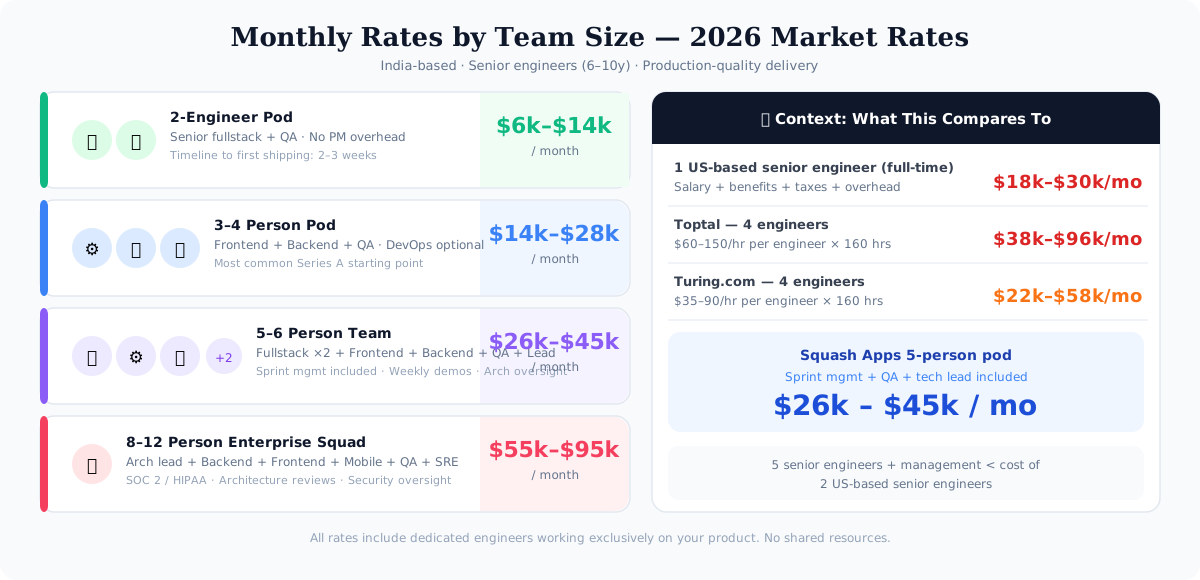
These are current market rates for India-based senior engineers with CTO-led delivery — the most common model for US, UAE, UK, and Australian clients looking for production-quality output without the cost of local hiring.
2-engineer pod (senior fullstack + QA)
$6,000–$14,000/month
What this buys: two dedicated full-time engineers. The fullstack engineer handles frontend and backend; the QA engineer owns testing and release quality. No PM overhead. You run standups and own sprint planning. Best for: early-stage products with a technical founder or CTO who can handle engineering management. Timeline to first shipping: 2–3 weeks.
3–4 person pod (frontend + backend + QA, optional DevOps)
$14,000–$28,000/month
What this buys: role specialisation without the overhead of a full team. A dedicated backend engineer handles APIs, data models, and integrations while a frontend engineer focuses on the user experience. QA is included. DevOps can be added part-time for an extra $1,500–$3,000/month. Best for: post-MVP products that are scaling and need frontend and backend to move in parallel. The most common starting point for early Series A companies.
5–6 person team (fullstack × 2 + frontend + backend + QA + part-time tech lead)
$26,000–$45,000/month
What this buys: a complete delivery team with a technical lead who owns architecture decisions and code quality. Sprint management is included — you get weekly demos and a structured delivery cadence. Engineers at this tier have typically 6–9 years of experience. Best for: Series A/B companies shipping multiple features in parallel, running across web and mobile simultaneously, or integrating AI into an existing product.
8–12 person squad (enterprise pod)
$55,000–$95,000/month
What this buys: a full cross-functional engineering squad — architecture lead, backend engineers, frontend engineers, mobile, QA, and a dedicated DevOps/SRE function. Includes weekly architecture reviews, security oversight, and compliance support. Best for: enterprise products with SOC 2 or HIPAA requirements, platforms serving millions of users, or companies augmenting a large in-house team with specialised capacity.
For reference, a single senior fullstack engineer in the US or UK costs $18,000–$30,000/month in fully-loaded employment cost (salary + benefits + taxes + overhead). The 5-person pod above costs less than two US-based senior engineers.
What's actually included in the price
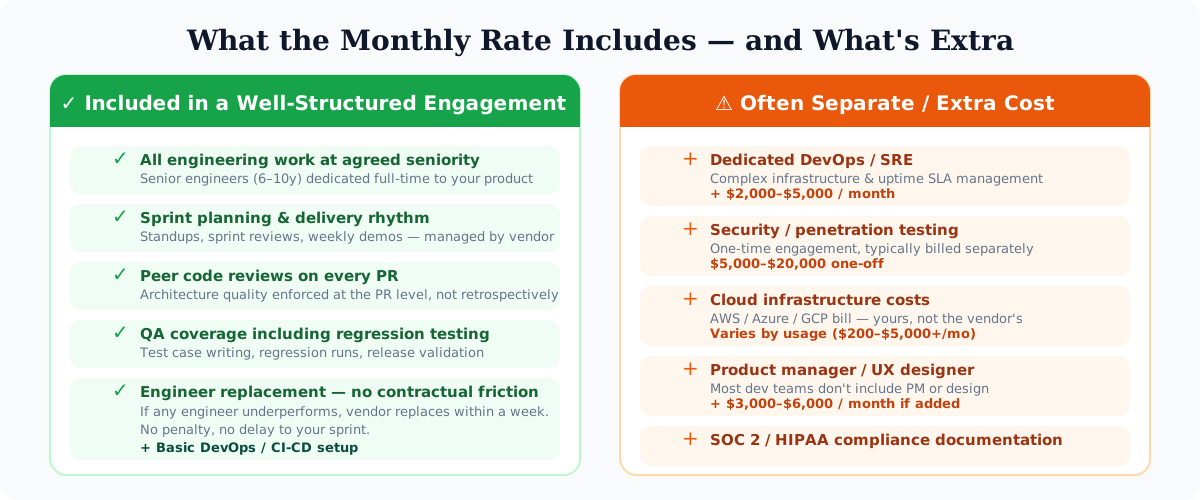
The biggest source of confusion in dedicated team pricing isn't the rate — it's what the rate covers. Here's what a properly structured dedicated team engagement includes, and what's typically extra.
Included in a well-structured engagement: All engineering work at the agreed seniority levels. Sprint planning, daily standups, and delivery rhythm management. Peer code reviews on every PR. QA coverage including test case writing, regression testing, and release validation. Access to the tech lead for architecture decisions. Weekly progress demos and async updates. Basic DevOps support (CI/CD pipelines, staging environments). Replacement of any engineer who isn't performing — no contractual friction.
Often extra or handled separately: Dedicated DevOps/SRE for complex infrastructure ($2,000–$5,000/month). Security reviews and penetration testing (typically a one-time project cost). Cloud infrastructure costs — the team builds and manages your infra, but the AWS/Azure/GCP bill is yours. Compliance documentation for SOC 2, HIPAA, or PCI (requires specialist legal and technical work beyond normal delivery). Product management and UX design — most development teams don't include a PM or designer, and adding one adds $3,000–$6,000/month.
The number to ask about before you sign anything: what is the fully-loaded monthly cost including any surcharges, tool costs, and minimum commitments?
The 4 variables that move the price
1. Seniority level. A junior engineer costs 30–40% less than a senior, but requires more oversight and produces more rework. For dedicated teams working without close client management, senior engineers (6–10 years) are almost always more cost-effective over a 6-month engagement. The rework cost from junior mistakes usually exceeds the savings.
2. Team location. India-based teams are the market standard for the rates quoted above. Eastern European teams (Poland, Romania, Ukraine) run 20–40% higher. LatAm teams (Colombia, Brazil, Argentina) sit between India and Eastern Europe. US/UK-based teams cost 3–5× more. For most clients, the India-based model with proper English communication and timezone overlap delivers the best risk-adjusted outcome.
3. Engagement model. Month-to-month (no contract) commands a premium of 10–15% versus a committed 6-month or 12-month term. The committed term is also better for team stability — engineers churn less when they have predictable work. If you're confident you'll need the team for 6+ months, the discount is worth taking.
4. PM and architecture layer. Pods without a tech lead cost less but require you to fill that gap. If you have an in-house CTO or VP Engineering who can manage architecture and prioritisation, you save $5,000–$8,000/month by not needing a vendor-side tech lead. If you don't, skipping it usually costs more in rework than the saving was worth.
Hidden costs to budget for
Ramp time: 2–4 weeks. Even experienced engineers need time to understand your codebase, domain, and product priorities. Plan for reduced output velocity in weeks 1–3. This isn't a failure — it's the cost of any new team member, regardless of seniority. Vendors who claim zero ramp time are setting expectations they can't meet.
Communication overhead: 5–10% of PM time. Running async daily updates, weekly demos, and architecture check-ins with a remote team requires structured habits. If you're a founder with no engineering manager, expect to spend 3–5 hours per week in the early months on communication and alignment. This stabilises after the first sprint cycle.
Tool costs. Development tools, project management software, code repositories, staging environments, and cloud compute are typically the client's cost. Budget $500–$2,000/month for a 5-person team's tooling stack depending on your cloud usage.
Transition if you exit. If the engagement ends, plan 2–4 weeks of documentation and knowledge transfer. The best vendors build documentation-first habits from day one, which reduces this cost significantly. Ask potential vendors how they handle offboarding — a good answer is "we document everything, so offboarding takes a week, not a month."
Comparing models: Toptal, Turing, and a CTO-led pod
The three most common options founders evaluate when considering a dedicated team are a freelancer marketplace (Toptal, Arc.dev), an AI-matched platform (Turing.com), and a managed engineering firm (like Squash Apps). Here's an honest comparison.
Freelancer marketplaces (Toptal, Arc.dev): You get individually vetted engineers at $60–150+/hour per person. There's no team management layer — you manage each engineer directly. Quality is generally high for the top tier, but you own all coordination, sprint management, and architecture decisions. Total cost for a 4-person team: $50,000–$100,000+/month. Best for: companies with a strong internal engineering leader who wants pre-vetted talent.
AI-matched platforms (Turing.com): Rates of $35–90/hour per engineer, matched algorithmically. Lower cost than Toptal, but the quality is more variable and vetting is automated rather than human-reviewed. No management layer included. Total cost for a 4-person team: $25,000–$60,000/month. Best for: teams with good internal management who can absorb quality variance.
CTO-led managed pod (Squash Apps model): A fully composed team with architecture oversight built in. You pay a pod rate rather than individual hourly rates, and the vendor manages delivery. Total cost for a 4-person team: $20,000–$35,000/month. Best for: founders without a technical co-founder or VP Engineering who need the team to run with minimal management overhead.
The Squash Apps model places a senior engineer in 14 days and includes CTO-level architecture review. See our dedicated team and staff augmentation service page for current team configurations.
Frequently asked questions
What's the minimum team size worth hiring?
Two engineers is typically the minimum viable team — one to build and one to test. A single engineer works as augmentation, but not as a "team." With two, you get peer review, parallel workstreams, and accountability. For a new product, a 3-person pod (senior fullstack + frontend + QA) is the most common starting configuration.
Is a dedicated team cheaper than hiring in-house?
For most companies under 50 engineers: yes, significantly. A single US-based senior engineer costs $180,000–$250,000/year in total compensation, plus benefits, office costs, and management overhead. A 5-person dedicated pod from India costs $26,000–$45,000/month — or $312,000–$540,000/year — for five senior engineers with QA and a tech lead included. The break-even point typically comes when you have a large, stable team (15+ engineers) and the management layer required for offshore coordination equals the salary gap.
How long does it take to get a team running?
The fastest vendors onboard in 7–14 days. Slower onboarding (4–6 weeks) is usually a sign that the vendor needs time to hire rather than pull from an existing talent pool. Ask any vendor: "how long until the engineers have committed code in our repo?" The answer tells you whether they have a real bench or are recruiting against your timeline.
What happens when a team member leaves?
In a well-structured dedicated team arrangement, replacement is the vendor's responsibility, not yours. The vendor backfills the position, handles ramp-up costs, and maintains continuity. This is a key difference from direct employment — engineer turnover is the vendor's operational problem, not a crisis for your product timeline. Ask what the average engineer tenure is on long-running engagements; the best vendors keep engineers on client projects for 18–36 months.
Can we start small and scale?
Yes — and this is the recommended approach. Start with a 2–3 person pod for the first sprint, evaluate the quality of code and communication, then scale once you've validated the working relationship. Adding engineers to a functioning pod takes 1–2 weeks. Scaling a broken team takes months and usually requires replacing it entirely.
Ready to get a real number? Our staff augmentation team can have a pod proposal in your inbox within 24 hours — team structure, seniority breakdown, and monthly cost. We also do AI-capable teams for products that need LLM integration built in from day one. Book a 15-min call with Srijith here — no pitch, just a straight conversation about what you're building and what it would take to staff it right.