
Full Stack Developer vs Specialist: When the Generalist Approach Works

Somewhere in your hiring plan there's a fork: do you hire one full stack developer who owns the feature end to end, or a frontend specialist and a backend specialist who each own half? Ask five CTOs and you'll get five confident, contradictory answers — because the honest answer is that it depends on exactly four things, and almost nobody names them.
I manage engineering pods at Squash Apps, where we field both shapes — full stack engineers who own products end to end and specialists in React, Node.js, and half a dozen other stacks. This is the framework we use to recommend one over the other, including the cases where the generalist approach quietly fails.
First, what full stack actually means
The term has been diluted to uselessness, so let's restore it. A real full stack engineer is T-shaped: genuinely deep in one layer — deep enough to pass a specialist's interview in it — and competent across the rest. They can design a database schema, build the API on top of it, ship the UI that consumes it, write the tests, and deploy the result. One owner, zero handoffs.
What the term often gets applied to is something else: shallow everywhere, deep nowhere. That engineer copies schema patterns from the last tutorial, builds APIs that work until they're under load, and ships UIs held together with effects. The entire full stack vs specialist debate goes wrong when this person is the mental model. The comparison only makes sense between a real T-shaped engineer and real specialists.
Where full stack wins
- Small products and MVPs. Below roughly five engineers, coordination is your biggest cost. Every feature that crosses a frontend/backend boundary needs an API contract negotiation, two tickets, two reviews, and a meeting when they disagree. One T-shaped owner deletes all of it.
- Features that span the whole stack. If a typical ticket touches schema, API, and UI — which describes most B2B SaaS work — a single owner ships it in one motion instead of a relay.
- Maintenance and inheritance. A codebase built by one good full stack engineer has one set of conventions. Two half-codebases built by two specialists have two — and the seam between them is where bugs live.
- Budget reality. One strong full stack engineer is comparable in rate to one specialist, and the work that would otherwise need two people gets done by one — not at twice the speed, but without the handoff tax.
Where specialists win
- Genuinely hard layers. Real-time collaboration, heavy animation and interaction work, query performance at scale, complex mobile — when one layer is the product's hard part, depth beats breadth, full stop.
- Existing large teams. Past a certain size, teams organise around layers anyway, and a generalist becomes a utility player on a team that needs position players.
- Performance rescue work. When the dashboard takes eight seconds to load, you want someone who has spent years inside that one problem — like a database specialist who reads execution plans for breakfast.
The 4-question decision framework
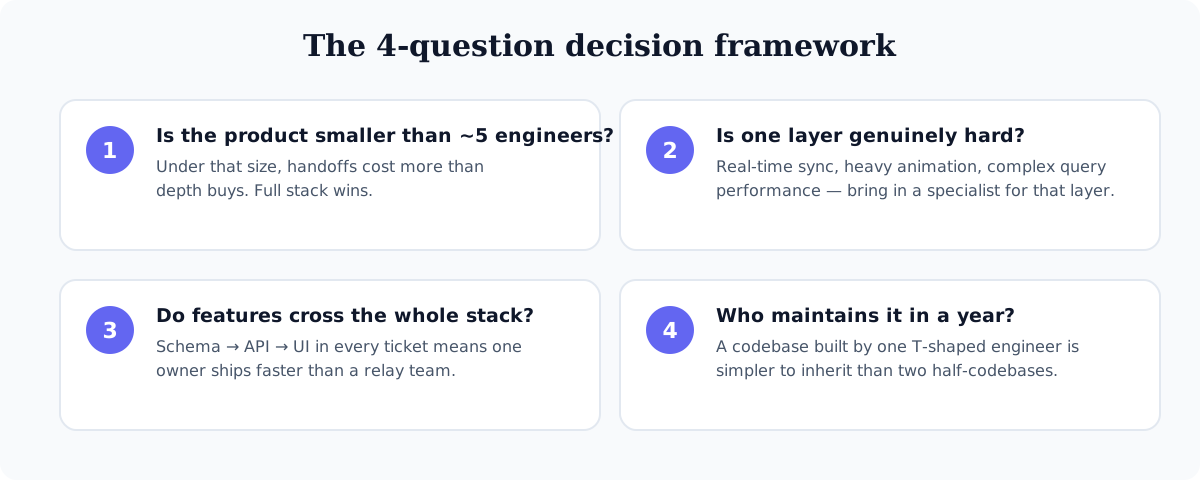
- Is the engineering team smaller than ~5 people? Below that line, handoffs cost more than depth buys. Default to full stack.
- Is one layer of your product genuinely hard? If yes, hire a specialist for that layer — and let full stack engineers cover the rest. Most products have exactly one hard layer, not three.
- Do your typical features cross the whole stack? Look at your last twenty tickets. If most touched schema, API, and UI, you're paying a relay tax that a single owner removes.
- Who maintains this in a year? If the answer is a small team or a future hire you haven't made, optimise for a coherent codebase — which is what a single T-shaped owner produces.
The pattern behind the framework: full stack is the default for small teams and cross-stack work; specialists are the targeted exception for hard layers and large teams. Companies get into trouble when they invert it — hiring specialists by default and discovering they've built a six-person team to do three people's work, or stretching one generalist across a problem that needed real depth.
What this looks like in shipped products
Two examples from our own delivery record. Hydesq, a desk-booking SaaS platform for the Australian market, was built by a compact full stack pod — React, Node.js, and PostgreSQL with mobile alongside — owning everything from data model to UI polish. No handoffs, one set of conventions, and a product that a small team can maintain. The same shape worked for a secure client portal MVP for an accounting firm: a focused React and Node.js build where splitting frontend from backend would have doubled the coordination without adding any depth the product needed.
Both projects would have been slower with specialists. Neither would survive its scale-up phase without bringing some in — which is the final point worth internalising: this isn't a permanent identity choice. Healthy products start generalist and add depth exactly where growth exposes hard layers.
When — and how — to switch shapes
The choice isn’t permanent, and the transition points are predictable. The first usually arrives when one layer starts generating a disproportionate share of bugs or slow tickets: queries that need real tuning, a frontend whose interaction complexity has outgrown competent-but-not-deep React. That’s the signal to add your first specialist — into that layer only, while full stack engineers keep owning cross-stack features. The second transition point is team size: somewhere past five to seven engineers, you’ll naturally form frontend and backend clusters, and fighting that gravity costs more than accepting it.
Two practical rules make the transition cheap. First, hire the specialist into the existing conventions — their first month is learning the codebase’s dialect, not rewriting it into their own. Second, keep at least one T-shaped engineer responsible for the seam between layers; the moment nobody owns the API contract end to end, you’ve re-created the handoff tax you originally avoided. Teams that follow both rules get depth where it matters while keeping the coherence that made the generalist phase fast.
The failure modes nobody mentions
Full stack failure mode: the jack of all trades you were warned about. You detect it in interviews by testing depth in their declared strong layer — a real T-shaped engineer survives a specialist-grade interview there; an impostor doesn't. We run exactly that test before any engineer joins our full stack pool, plus CTO-level review on every pull request after.
Specialist failure mode: the seam. Two excellent engineers, one mediocre integration. The API the backend dev wanted to build isn't quite the API the frontend dev needed, and the negotiation produces a compromise neither would have designed alone. You mitigate it with strong contracts and a lead who owns the seam — which is a real, ongoing cost that should be priced into the specialist option.
Deciding for your situation
Run your product through the four questions. If you land on full stack and want to skip the sourcing problem, we'll send you three hand-picked profiles within 24 hours — engineers who've passed a specialist-depth interview in at least one layer, tell us what you're building. If you land on specialists, the same process works per stack. And if you're still deciding how to structure the whole engagement, our guide to hiring a dedicated development team covers the team-shape question from the top down, while the cost breakdown puts numbers on each option.
Frequently asked questions
When should I hire a full stack developer instead of specialists?
Default to full stack when your engineering team is under about five people, your typical features cross the whole stack (schema, API, and UI), and you want one coherent codebase to maintain. Below that size, handoff coordination costs more than specialist depth buys.
When are specialists the better choice?
When one layer of your product is genuinely hard — real-time collaboration, heavy interaction work, query performance at scale, or complex mobile — or when the team is already large enough to organise around layers, or for performance-rescue work that needs deep single-domain expertise.
What is a T-shaped full stack engineer?
An engineer who is genuinely deep in one layer — deep enough to pass a specialist's interview in it — and competent across the rest, able to take a feature from database schema through API to UI, tests, and deploy. It is the opposite of shallow-everywhere, which is the failure mode the debate usually conflates with full stack.
Do I have to choose permanently?
No. Healthy products start generalist and add depth where growth exposes a hard layer. Add your first specialist into that layer only, hire them into the existing conventions, and keep at least one T-shaped engineer owning the seam between layers.
Asha S
Engineering Manager, Squash Apps