
How to Build an AI Application: A Step-by-Step Guide for 2026

In 2025, a client showed us a demo they'd built over a weekend. It worked beautifully: you could paste in a contract, ask a question, and get a precise answer with the relevant clause highlighted. Two hundred people had signed up for the waitlist after the demo video went viral.
Eight months later, the product still hadn't shipped. The demo worked on 30 contracts that had been manually selected and preprocessed. On the actual contracts users uploaded — varied formats, scanned PDFs, tables, handwritten amendments — the answer quality dropped below the threshold where it was better than reading the document yourself. The eval framework they needed to catch and fix this hadn't been built before the demo was shown.
This is the most common failure mode in AI product development. The gap between a demo and a product isn't a gap in AI capability — it's a gap in engineering infrastructure: evaluation frameworks, data pipelines, edge case handling, and monitoring. This guide covers how to close that gap, step by step.
Step 1: Define the problem before choosing technology
The instinct in AI product development is to start with a model and find a problem that fits. Start with GPT-4, see what it can do, build a feature around its capabilities. This produces demos.
The productive direction is reversed: what specific decision or task is your user doing where AI output that is 80–90% accurate creates significantly more value than they produce manually today? The answer to this question determines everything downstream — the architecture, the eval framework, the acceptable latency, the model choice.
Three constraints worth working through explicitly before any technical decisions:
What's the cost of a wrong answer? In a legal contract review tool, a wrong answer that causes someone to miss a critical clause is expensive. In a product description generator for e-commerce, a wrong answer gets edited. These have completely different implications for how much QA infrastructure you need and what accuracy threshold is acceptable to ship.
Where does your proprietary data live, and how structured is it? If your value proposition depends on reasoning over your customers' data — their documents, their tickets, their history — you'll need a retrieval layer. If it depends on general reasoning or public knowledge, you may not.
What does the user do when the AI is wrong? The best AI products have clear fallback paths: the user can see the AI's reasoning, identify where it went wrong, and correct it. Products where the user can't tell if the answer is right are fragile regardless of average accuracy.
Step 2: Choose your architecture
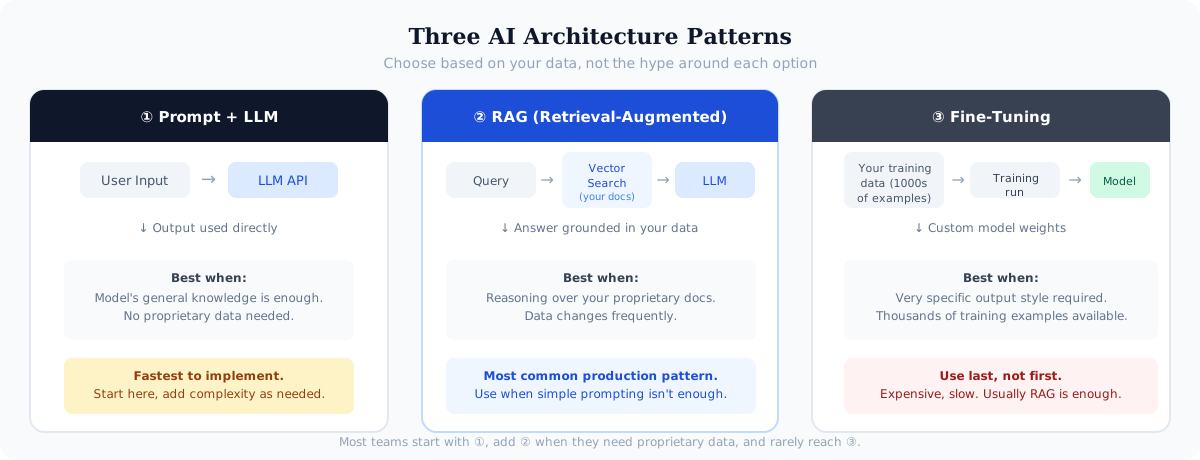
In 2026, the meaningful architectural choice is almost always between simple prompting, RAG (Retrieval-Augmented Generation), and fine-tuning. The choice matters because each has fundamentally different implications for build complexity, cost, and what happens when your data changes.
Simple prompting means sending user input — possibly with some additional context — directly to an LLM. The model reasons over its training data and whatever you inject in the prompt. This is the right first choice when: the model's general knowledge is sufficient, the output doesn't need to be grounded in your specific data, and you're not sure yet exactly what form the product will take. Start here. It's fast to implement, easy to iterate on, and works better than most teams expect.
RAG means retrieving relevant documents or data from your own systems, injecting them into the prompt context, and having the model synthesize an answer grounded in what was retrieved. The key technical components: a document ingestion pipeline, a chunking strategy (how you split documents), an embedding model, a vector database, and a retrieval layer that finds the most relevant chunks at query time. Use RAG when the model's training data isn't sufficient for accurate answers and you have proprietary documents or structured data that should ground the responses.
Fine-tuning means training or fine-tuning a model's weights on your own data. The result is a model that reliably produces outputs in a specific style, format, or domain. Use this rarely and late: it requires thousands of high-quality training examples, takes significant compute time and cost to run, and doesn't update automatically as your data changes. The correct reasoning is: can I achieve acceptable output quality with prompting or RAG? If yes, don't fine-tune. Fine-tune only when the answer is genuinely no.
Step 3: Pick your model
In 2026, the leading frontier models — GPT-4o, Claude Sonnet, Gemini 2.0 Flash — are broadly competitive on general reasoning. The practical selection criteria are more operational than qualitative:
Cost at your expected scale. For low-volume B2B products, the cost difference between models is small. For consumer products with millions of queries per month, a 5× cost difference between models compounds quickly. Calculate the expected monthly API cost at your projected volume before committing.
Context window size. RAG with long documents requires models that handle large context windows reliably. Claude's 200K token window and GPT-4o's 128K window handle most use cases; smaller or older models may not.
Latency. For user-facing features where response time matters, smaller models (Claude Haiku, Gemini Flash) are significantly faster. For batch processing where latency is irrelevant, use the most capable model.
The most reliable model selection process: prototype with whichever model is fastest to access, then run structured evals on your actual use case with 50–100 real examples before making a final choice. Benchmark results rarely predict per-task quality accurately.
Step 4: Build your evaluation framework first
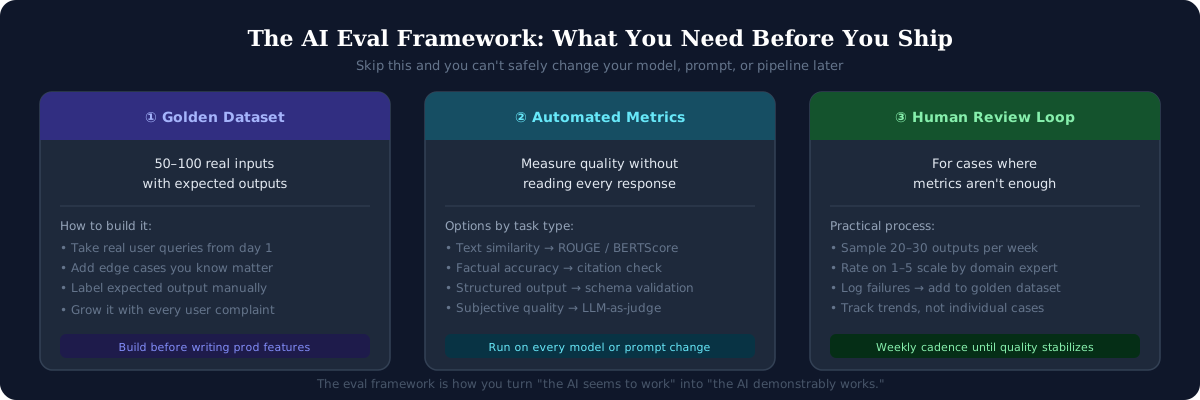
This step is consistently skipped by teams in a hurry to ship. It is also the most significant predictor of whether an AI product improves over time or gradually degrades.
Without a structured eval framework, you cannot safely change your model (will the new version break existing behavior?), safely change your prompt (is quality actually better?), or catch regressions when edge cases surface in production. You're flying without instruments.
A minimal eval framework has three components. First, a golden dataset: 50–100 representative inputs with expected outputs, labeled manually by a domain expert. Build this before writing your first production feature. It will feel premature. Do it anyway. Second, automated metrics that run on every significant code change: what exactly to measure depends on your task (text similarity metrics for summarization, schema validation for structured outputs, factual consistency checks for retrieval-heavy tasks). Third, a human review process for the cases where automated metrics are insufficient — typically a weekly sample of 20–30 outputs reviewed by someone with domain expertise.
The eval framework is a living system. Every user complaint about output quality should add a test case. Every production edge case should become a regression test. Over 6–12 months, a well-maintained eval dataset is one of the most defensible assets an AI product team can have.
Step 5: Design your data pipeline
The AI model is not the hardest engineering problem in an AI application. The data pipeline is. This is consistently underestimated.
For a RAG system, the data pipeline includes: document ingestion (parsing PDFs, handling scanned images, extracting tables, dealing with format variation); chunking (how you split documents affects retrieval quality significantly — fixed-size chunks, semantic chunks, and hierarchical chunks all have different trade-offs); embedding (which embedding model, how you handle updates when documents change); retrieval (exact matching vs. semantic search, how many chunks to retrieve, re-ranking); and output post-processing (validating the structure of the model's response, catching errors, handling citations).
Common failure modes that don't appear in demos: model outputs with the wrong JSON structure when the document is ambiguous; latency spikes when retrieved chunks are unusually long; hallucinations that reference documents not in the retrieval set; context window overflows when multiple long documents are retrieved; and accuracy degradation on scanned PDFs that OCR imperfectly.
Design your pipeline to catch these explicitly. Each failure mode should have a defined detection mechanism and a fallback behavior — not just an error log.
Step 6: Ship, measure, and iterate
The defining characteristic of successful AI products in production isn't the sophistication of the model or the elegance of the RAG pipeline. It's the speed and discipline of iteration. Teams that ship early, collect real user feedback, add those cases to their eval dataset, and iterate systematically consistently produce better products than teams that optimize in staging.
What "iterate on evals" means in practice: when a user reports that the AI gave a wrong answer, that input and the correct answer become a new entry in your golden dataset. When you catch a production edge case, it becomes a regression test. After 3–6 months of systematic collection, your eval dataset reflects the real distribution of how your product is used — which is almost always different from what you assumed at the start.
The practical shipping advice: don't wait for perfect accuracy. Ship when accuracy is high enough that the product is useful for the majority of real use cases, the fallback path for failures is clear, and you have the eval infrastructure to detect and fix regressions. For most B2B AI products, this threshold is achievable in 2–3 months of focused engineering. The next 6 months of iteration are what actually make it good.
Do you need a technical co-founder to build an AI product?
No — but you need technical leadership in the team. The architectural decisions in AI development aren't made at the AI layer; they're made in the engineering infrastructure around it. Which chunking strategy to use for your document types, how to structure your eval pipeline, whether your vector database choice will hold up at your projected scale, how to handle multi-tenancy in your RAG system — these require engineers who have built production AI systems before.
A generalist software engineering team can implement whatever spec you give them. They can't reliably make the architectural calls that determine whether the system works at scale. This is why the Squash Apps AI team structures AI projects with a senior engineer who has shipped production RAG systems as the technical lead — not just to write the LLM integration code, but to make the architecture decisions that don't appear in any tutorial.
If you're building an AI product and want a concrete assessment of your current architecture — what's solid, what will break at scale, what to build first — book a 15-minute technical call. No sales pitch; just a direct conversation about what you're building and how to approach it.
Frequently asked questions
What's the difference between RAG and vector search?
Vector search is a component of RAG, not a synonym. Vector search converts text into numerical vectors and finds the most semantically similar vectors in a database — it's the retrieval mechanism. RAG is the broader pattern: retrieve relevant content via vector (or other) search, inject it into the LLM's prompt context, and generate an answer grounded in what was retrieved. You can have vector search without RAG (for similarity-based recommendations, for example); you can't have RAG without some retrieval mechanism, typically vector search.
How do I choose between OpenAI and Anthropic?
For most production use cases in 2026, both GPT-4o and Claude Sonnet are capable enough that the choice comes down to: price per token at your volume, context window requirements, API reliability based on your region and traffic patterns, and which SDK fits your existing stack better. Run evals on your actual task with both models before committing. The quality difference on most tasks is smaller than the marketing suggests; the operational differences (rate limits, latency, support) may matter more.
How long does it take to build an AI product?
A working demo: 1–2 weeks. A production MVP with eval framework, proper error handling, and basic monitoring: 2–3 months. A robust system with retrieval pipeline, observability, regression coverage, and production-hardening: 4–6 months. The gap between demo and production is almost entirely data engineering, eval infrastructure, and edge case handling — not model integration. Budget accordingly.
What should I look for when hiring AI engineers?
Three things that distinguish AI engineers who can build production systems from engineers who can build demos: have they built and maintained an eval framework in production? (this is the most reliable signal); have they designed chunking and retrieval strategies for document types similar to yours? (ask for specifics); and can they explain why they'd choose RAG over fine-tuning for your use case, with concrete trade-off reasoning? Engineers who answer the last question by reaching immediately for the most sophisticated solution are usually less experienced than engineers who argue for the simplest approach that works.