
Staff Augmentation vs Managed Team: Which Model Fits Your Stage?

The buyer confusion here is real. Both models involve external engineers building your product. Both are presented under the same category of "outsourcing." Both vendors will confidently tell you they're the right fit. The actual difference only becomes visible six months into the engagement — when either the model is working smoothly or you're spending two days a week managing remote contractors instead of running your company.
This post is a practical breakdown of the two models: what each actually requires from you, which company stages they suit, and how to tell which one you need before you sign a contract.
Staff augmentation: what it is and what it demands
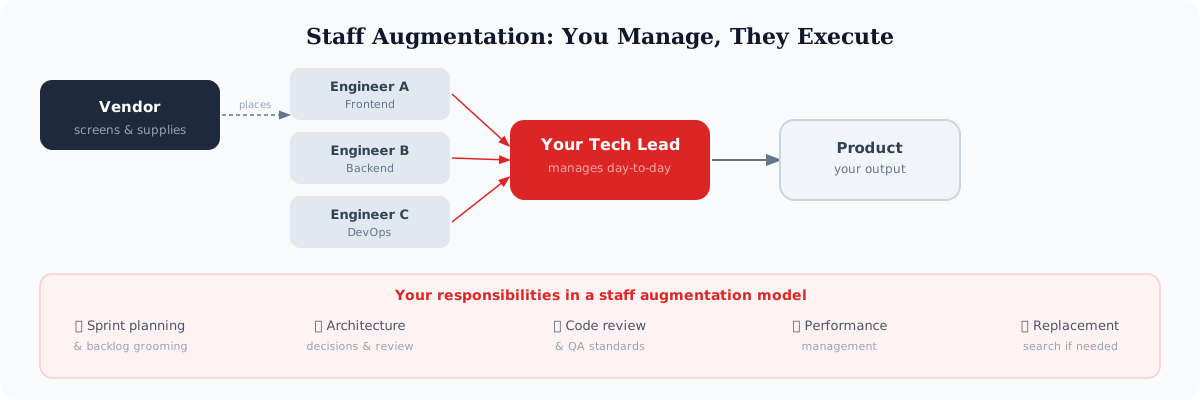
Staff augmentation means hiring individual engineers — usually through a marketplace or agency — who join your team and work under your direction. You manage them. You run standups. You set the sprint cadence, review pull requests, make architecture decisions, and handle performance issues if they arise. The vendor screens and supplies the talent; you do everything else.
The appeal is obvious: you get technical control. Every decision about how the software is structured, how the sprint is run, and how performance is evaluated stays with you. If you have a strong engineering lead in place who has managed distributed teams before, this flexibility is genuinely valuable — you're not paying for a management layer you don't need.
The demand is equally obvious: you need a strong engineering lead. Without one, staff augmentation doesn't deliver engineering leadership — it delivers four capable engineers making four different architectural decisions with nobody coordinating them. That's not a criticism of the model. It's a description of what the model does and doesn't provide.
The other demand is bandwidth. Managing a team of remote contractors takes real time — 8–12 hours a week for a team of four or five, when you account for hiring, onboarding, daily coordination, code review, and sprint management. For a founder who also has investors to report to, customers to speak with, and a product to define, that 8–12 hours is significant.
Managed team: what it is and what it delivers
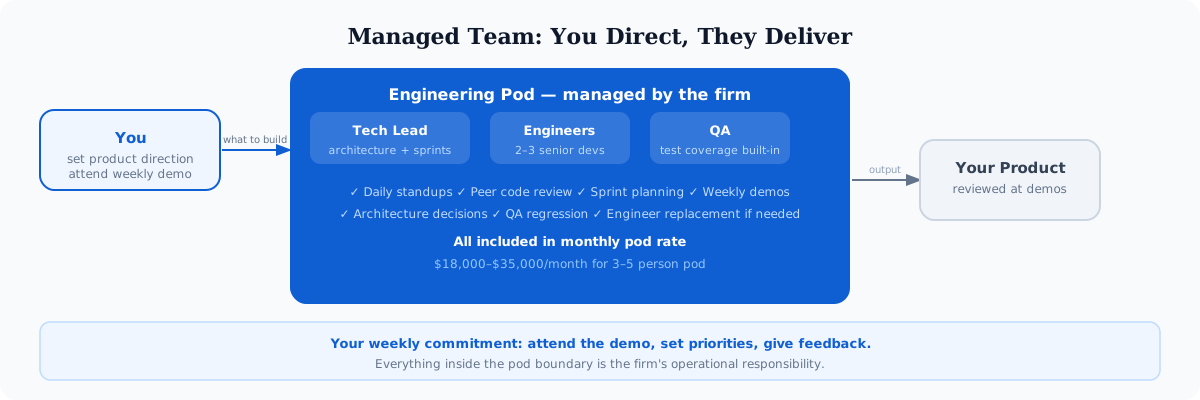
A managed team (sometimes called a dedicated engineering pod) is a different arrangement. You're not hiring individual engineers — you're engaging a firm that assembles a team and manages the delivery themselves. You own the product direction: what to build, in what order, and to what business objective. The firm owns delivery: how it gets built, to what quality standard, and on what timeline.
In practice, this means: the tech lead on the pod makes architecture decisions within the constraints of the overall system. Engineers do peer review on each other's PRs before anything merges. QA coverage is built into the sprint cycle. Standups happen without you. You see the output at a weekly demo, tell them what matters next, and the cycle continues.
What you give up is granular control. You can't tell the tech lead to use a specific ORM or restructure the sprint board the way you prefer. You're buying an outcome, not a resource. For most founders and product leaders, that trade-off is very welcome — but for companies with strong internal engineering opinions and an existing tech lead who wants to manage engineers directly, it feels like interference.
The managed model also comes with built-in continuity. If an engineer on the pod leaves or isn't performing, that's the firm's operational problem. Replacements happen within the team without a search process on your end. For companies who've been through the pain of a key contractor leaving mid-project, this is worth more than it sounds.
Decision framework: which model fits your stage
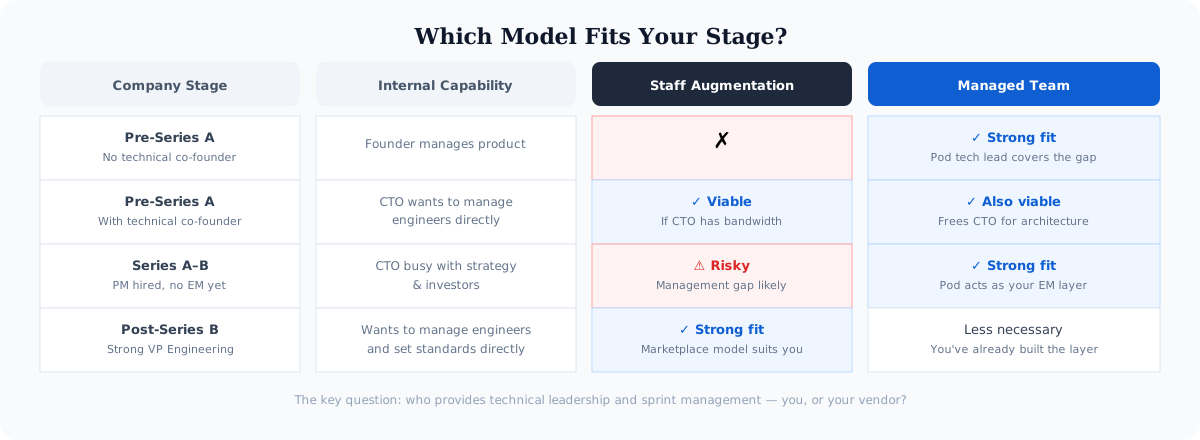
Pre-Series A, no technical co-founder. This is the clearest case for a managed team. You don't have an internal engineering lead to absorb management overhead. Staff augmentation would require you — a non-technical founder, or a founder who should be focused on customers and fundraising — to run daily engineering operations. A managed pod with a tech lead handles that. You direct, they deliver. The cost is typically $18,000–$30,000/month for a 3–4 person pod, which compares favourably to the $15,000–$20,000/month burn of a single mid-level US-based engineer without any management layer included.
Pre-Series A, with a technical co-founder who wants to manage engineers. Staff augmentation is viable here — provided your technical co-founder genuinely has the bandwidth and the inclination to manage a distributed team. The honest question to ask: does your CTO want to spend 40% of their week on sprint coordination and code review, or do they want to spend it on architecture and product? If the latter, a managed team is still the right call.
Series A–B, in-house product manager but no engineering manager. This is a common situation: you've hired a PM to own the roadmap, but your engineers are still reporting to the founder or to the CTO who now has broader responsibilities. A managed team slots in cleanly — the pod's tech lead functions as the engineering manager layer you haven't yet hired. This is particularly useful for companies who are building AI features alongside their core product and need engineers who have done that before. Our AI application development team has built production RAG pipelines, LLM integrations, and evaluation frameworks — that expertise matters when you're adding AI to a product with existing users and can't afford architectural mistakes.
Post-Series B, strong VP Engineering in place. At this stage, staff augmentation often makes more sense. You have an internal engineering leader who can manage people, run architecture reviews, and set quality standards. The managed model introduces an overhead layer you've already built internally. Toptal, Arc.dev, and similar marketplaces give you access to pre-vetted individual engineers who slot into your existing process.
Enterprise with a defined project and an internal sponsor. Depends on the project scope. For well-scoped integration or development projects where the requirements are clear and an internal technical owner will oversee the work, staff augmentation with a strong vendor-supplied lead is viable. For ambiguous or complex builds — new platforms, AI systems, internal tools that replace a manual process — managed delivery reduces risk.
The hybrid model (and when it makes sense)
A small number of companies end up in a hybrid arrangement: a managed pod handling core product development, with individual staff augmentation engineers brought in for specific specialisms — a security review, a data engineering push, a mobile platform you're not ready to staff permanently. This works well when the managed pod has a tech lead strong enough to onboard and direct specialists without the client having to manage that relationship directly.
It doesn't work well when the staff-augmented engineers are added to fill headcount gaps in the managed pod, effectively turning a managed engagement into a staff augmentation one. If you find yourself wanting to manage individuals within what's supposed to be a managed team, the model mismatch usually means you've outgrown the firm or the engagement structure needs to be renegotiated.
What it costs in practice
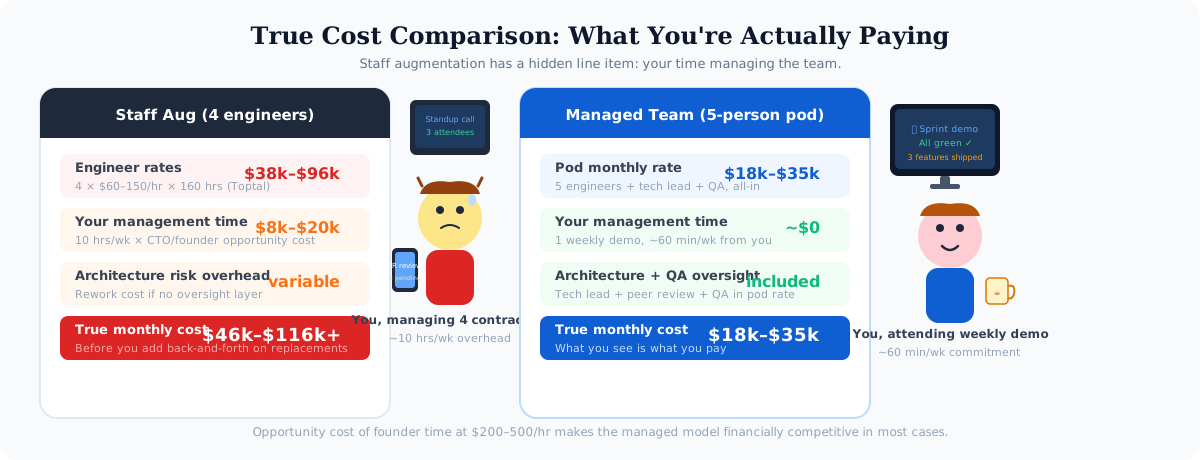
Staff augmentation billing is per engineer per hour. A senior engineer on Toptal runs $80–$130/hour; a 3-person team at 160 hours/month each is $38,000–$62,000/month before any management overhead you provide internally. Junior engineers are cheaper, but the supervision they require often negates the savings.
Managed team billing is per pod per month. Our staff augmentation and dedicated team service runs $18,000–$35,000/month for a 3–5 person pod with tech lead and QA included. The lower absolute number reflects geography (India-based senior engineers at market rates) and model (you're buying managed output, not raw hours). The PM overhead that would otherwise land on your desk is already absorbed.
The honest comparison isn't managed team vs. staff augmentation. It's: managed team vs. staff augmentation plus the internal management cost. When you price in 8–12 hours of founder or CTO time per week at opportunity cost, the managed model is usually less expensive at equivalent output.
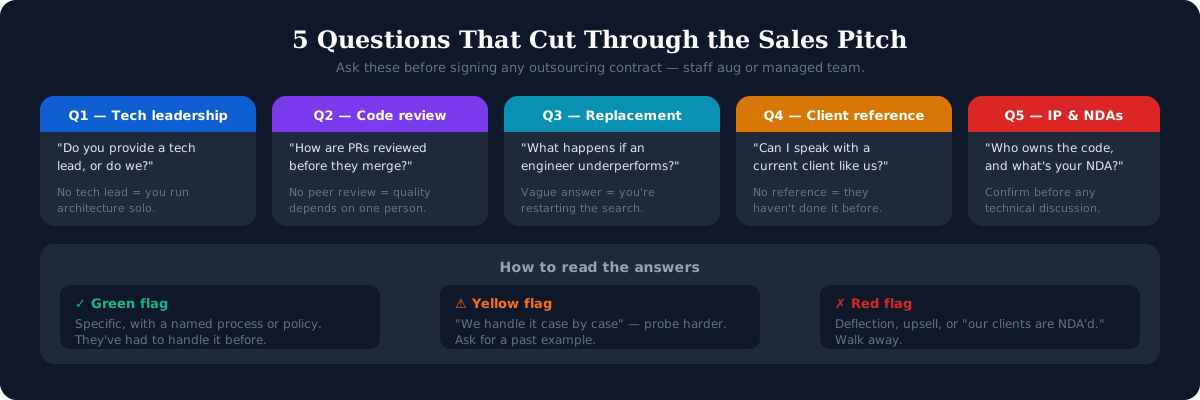
Questions to ask any vendor before you decide
Regardless of which model you're leaning toward, these questions cut through the sales pitch quickly. Does the vendor provide a tech lead, or is the expectation that your team provides technical direction? How are code reviews handled — by the vendor's team, by the client, or not at all? What happens when an engineer on the engagement leaves — who handles the replacement and how long does it take? Can you speak with a current client at a similar company stage? If a vendor can't answer the replacement question with specifics, treat that as a signal about how much they've actually had to handle it.
If you want to talk through which model fits your current situation — no pitch, no commitment — book a 15-minute call here. We'll ask a few questions about your setup and tell you honestly whether a managed team makes sense or whether a marketplace like Toptal would serve you better.
Frequently asked questions
Is staff augmentation cheaper than a managed team?
On a per-engineer rate, staff augmentation from Eastern European vendors is often cheaper. On a total-cost basis — including the internal management time that staff augmentation requires — managed teams are frequently comparable or less expensive. The calculation changes significantly based on what your technical leadership costs and how much of their time you can afford to allocate to managing contractors.
Can a managed team replace my need to hire full-time engineers?
For many pre-Series A and Series A companies: yes, for 12–24 months. The pod model is designed to function as an engineering team, not as a supplement to one. The point at which it makes sense to transition to full-time hiring is usually when you have a clear product-market fit, a stable technical foundation, and enough throughput requirements to justify the higher fixed cost of full-time employment in your target geography.
What's the difference between a dedicated team and a managed team?
"Dedicated team" usually refers to engineers who work exclusively on your product rather than being shared across clients — which is true of both staff augmentation and managed arrangements. "Managed team" specifies who runs the delivery. In practice, many firms use the terms interchangeably. The key question is always: who provides the tech lead, the sprint management, and the quality oversight?
How long does it take to get a managed team started?
For Squash Apps, the typical timeline from initial call to first sprint planning is 2–3 weeks: one week for scoping and contracts, one week for team assembly and codebase familiarisation (if there's an existing codebase), and a kickoff sprint in week three. Staff augmentation with a marketplace like Toptal can move faster for individual engineers — sometimes 5–7 days — but the onboarding overhead lands on the client's side.
Jai K
Engineering Lead, Squash Apps