
Node.js Developer Hiring Guide: Skills, Rates, and Red Flags

Node.js has a hiring problem that most stacks don't: everyone already writes JavaScript. A frontend developer can read an Express tutorial on Sunday and call themselves a backend engineer on Monday. The syntax will be fine. The schema design, the queue handling, and the behaviour under load will not.
I've reviewed hundreds of Node.js engineers over the past decade — for our own team and on behalf of clients who asked us to staff Node.js developers into theirs. This guide is the filter we actually use: what a Node.js developer really does, the three skill areas worth testing, a practical interview structure, the red flags that reliably predict failed hires, and an honest section on rates.
What a Node.js developer actually does
Job listings say things like REST APIs and microservices. In practice, a senior Node.js engineer on a product team spends their time on four things:
- API design and versioning — contracts that frontend and third-party teams can build against without weekly breakage.
- Data work — schema design, migrations, indexing, and the query patterns that decide whether your dashboard loads in 80 milliseconds or 8 seconds.
- Async infrastructure — background jobs, queues, webhooks, retries. The invisible plumbing that separates a product that scales from one that loses orders silently.
- Integration glue — payment providers, messaging APIs, CRMs. Node.js is often chosen precisely because it's the best integration layer in the business.
Notice what's missing: framework trivia. Whether your team uses Express, Fastify, or NestJS matters far less than whether the engineer can do the four things above. Frameworks are learned in a week; judgment is not.
The skills that matter (and the ones that don't)
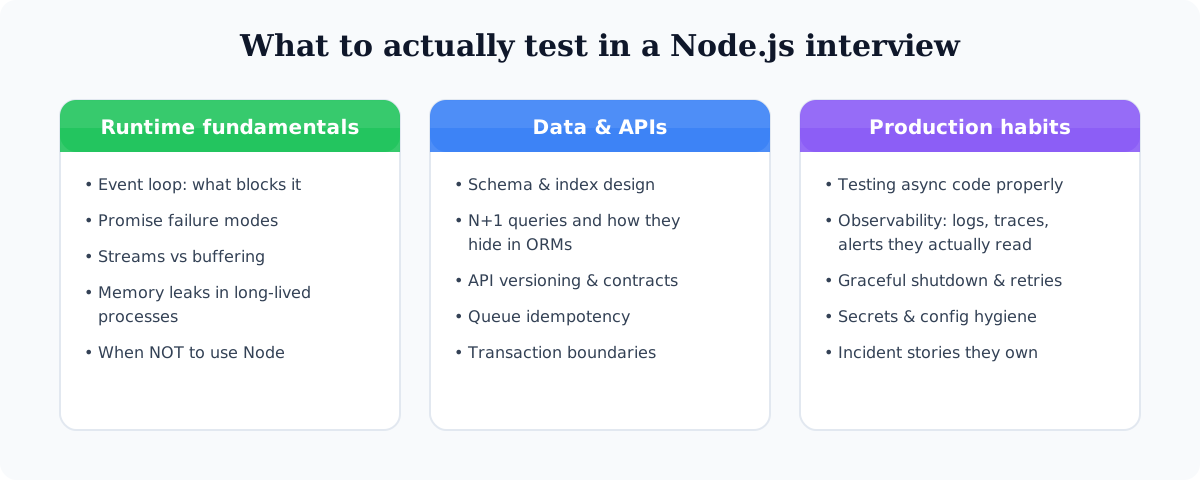
1. Runtime fundamentals
Node.js runs JavaScript on a single-threaded event loop. An engineer who doesn't deeply understand that will eventually block it — and a blocked event loop doesn't fail loudly, it just makes every user's request slow at once. Ask candidates what kinds of work block the event loop and how they'd handle a CPU-heavy task (worker threads, a job queue, or simply a different language for that service — a senior engineer will happily say Node is the wrong tool for some jobs).
2. Data and API judgment
Most production incidents we get called into are database problems wearing a Node.js costume. ORMs like Prisma and TypeORM make it easy to write queries that work in development with 100 rows and collapse in production with 10 million. Test for N+1 query awareness, index reasoning, and transaction boundaries. An engineer who can design a clean schema for a non-trivial domain is worth more than one who has memorised every Express middleware pattern.
3. Production habits
The difference between mid-level and senior is rarely code — it's what surrounds the code. Does the candidate write tests for async failure paths, not just happy paths? Do they reach for structured logging and traces before adding console.log? Can they describe an incident they owned, what the root cause was, and what they changed afterwards? Engineers with real production scar tissue answer that last question with specifics. Engineers without it answer in generalities.
A 90-minute interview that actually works
You don't need five rounds. We've converged on three blocks:
- 30 minutes — schema and API design. Give a realistic domain (bookings, invoicing, inventory) and ask them to design the tables and the endpoints. You'll learn more here than from any algorithm puzzle.
- 40 minutes — code reading and debugging. Hand them a real, slightly broken async code sample: a promise that swallows errors, a webhook handler that isn't idempotent, a query in a loop. Ask what worries them. Senior engineers spot the unhandled rejection and the missing idempotency key; juniors comment on variable names.
- 20 minutes — production war stories. Ask about the worst incident they've owned, a time they had to say no to a deadline, and what they monitor on a service they run. You're testing for ownership, not vocabulary.
If you're not technical enough to run this yourself, borrow someone who is — or work with a partner whose review process you can audit. Every engineer we place is interviewed this way and every pull request is reviewed by a CTO-level lead before merge, which is exactly the safety net a non-technical founder is buying.
Red flags that predict failed hires
- Framework-first answers. Every question comes back to a library name rather than a reason. Libraries change; reasons transfer.
- No opinion on TypeScript. In 2026, a senior Node.js engineer has shipped TypeScript in production and has opinions about strictness. Indifference usually means inexperience.
- Can't explain a past schema. Ask them to draw the data model of their last project. Engineers who genuinely built it can; engineers who orbited it can't.
- Everything was someone else's fault. Incident stories where the candidate was never responsible for anything are a character signal, not a technical one.
- Portfolio of demos, no operations. Twenty repos with no tests, no CI, and no deployment story describe a hobbyist pattern — fine to grow, risky to hire as your senior backend owner.
What Node.js developer rates actually depend on
Rates vary enormously, and most of the variation comes down to four factors rather than raw skill: seniority (someone who has operated production systems commands a premium over someone who has only built features), region (US and Western European engineers cost a multiple of equally strong engineers in India — timezone overlap and communication quality are what you should actually vet), engagement model (freelance marketplaces look cheaper per hour but carry rework and continuity risk; dedicated full-time engineers cost more per month and compound knowledge in your codebase), and scarcity of the surrounding skills — a Node.js engineer who can also own infrastructure or lead a small pod is priced as more than the sum of parts.
For reference, our own dedicated Node.js engineers start at $10k/month for a single senior engineer working full-time on your project, with no recruitment fee and a two-week notice period. Whatever partner you evaluate, insist on the same transparency: a monthly number, what it includes, and how you exit.
If you're weighing this against building an in-house team, our guide on what a dedicated development team costs breaks down the full comparison, and staff augmentation vs managed team explains the two engagement structures most companies mix up.
Express, Fastify, or NestJS — should it change who you hire?
Mostly no, but the way a candidate talks about the choice is itself a useful signal. Express is the lowest-friction option and still fine for small services; its weakness is that it imposes no structure, so a five-engineer codebase becomes five dialects. Fastify is the performance-minded modern equivalent with a better plugin and validation story. NestJS adds an opinionated architecture — modules, dependency injection, decorators — that pays off when a team and codebase grow, which is why it is our default for new product backends. A strong candidate can articulate roughly that trade-off and then say the most senior thing possible: that they would match the framework to your team rather than to their preference. Be wary of the inverse — a candidate who insists your existing, working Express codebase must be rewritten in their favourite framework is telling you how they will spend your first three months.
The same logic applies to runtimes. Bun and Deno come up in interviews now, and curiosity is a good sign — but a senior engineer distinguishes between what they would try in a side project and what they would bet your production system on.
What shipped Node.js work looks like
Talk is cheap in hiring guides, so here are two Node.js projects from our own delivery record. We built a fleet management ERP from scratch in 12 weeks — Node.js and PostgreSQL on AWS with a React frontend — taking it from first commit to a production system running daily operations. And our cloud logistics platform serves more than 1,000 concurrent enterprise users on a Node.js backend. Ask any partner you evaluate for equivalent specifics: what they built, on what stack, and what it handles in production today.
The decision in one paragraph
Hire for runtime understanding, data judgment, and production habits — in that order — and treat framework names as noise. Run one 90-minute structured interview instead of five vague ones. Walk away from candidates who can't draw their last schema or own their last incident. And if you'd rather skip the sourcing entirely, we'll send you three hand-picked Node.js profiles within 24 hours — tell us what you're building and interview them with the exact playbook above. If your project needs end-to-end ownership rather than a backend specialist, look at full stack engineers instead — and if you're not sure which you need, that's a fifteen-minute conversation, not a commitment.
Frequently asked questions
What should I test when hiring a Node.js developer?
Test three areas, in order: runtime and event-loop understanding, data and API judgment (schema design, N+1 awareness, transaction boundaries), and production habits (testing async failure paths, structured logging, owning incidents). Framework knowledge — Express, Fastify, or NestJS — matters far less, because it is learned in a week.
How long should a Node.js technical interview take?
One structured 90-minute interview beats five vague rounds: 30 minutes on schema and API design, 40 minutes reading and debugging a real async code sample, and 20 minutes on production war stories to test ownership rather than vocabulary.
What do Node.js developer rates actually depend on?
Four factors more than raw skill: seniority, region (US and Western European engineers cost a multiple of equally strong India-based engineers), engagement model (freelance marketplaces versus dedicated full-time), and whether the engineer also owns adjacent skills such as infrastructure. Our dedicated Node.js engineers start at $10k/month full-time with no recruitment fee.
Does the framework change who I should hire?
Mostly no. Hire for runtime understanding, data judgment, and production habits, and treat framework names as noise. How a candidate reasons about the Express-versus-Fastify-versus-NestJS trade-off is a more useful signal than which one they prefer.