
RAG vs Fine-Tuning: Which Approach Is Right for Your AI Product?

You're building an AI product. Or adding AI to an existing one. At some point, you need the AI to know about your data — your product documentation, your customer contracts, your internal SOPs, your company knowledge base.
The model you're using (GPT-4o, Claude, Gemini) doesn't know any of that. So how do you get it to use your specific information without hallucinating? There are two primary approaches, and picking the wrong one is one of the most common and expensive mistakes in AI product development.
This guide explains both approaches in plain English, gives you a four-question decision framework, and tells you when neither one is necessary.
RAG explained in plain English
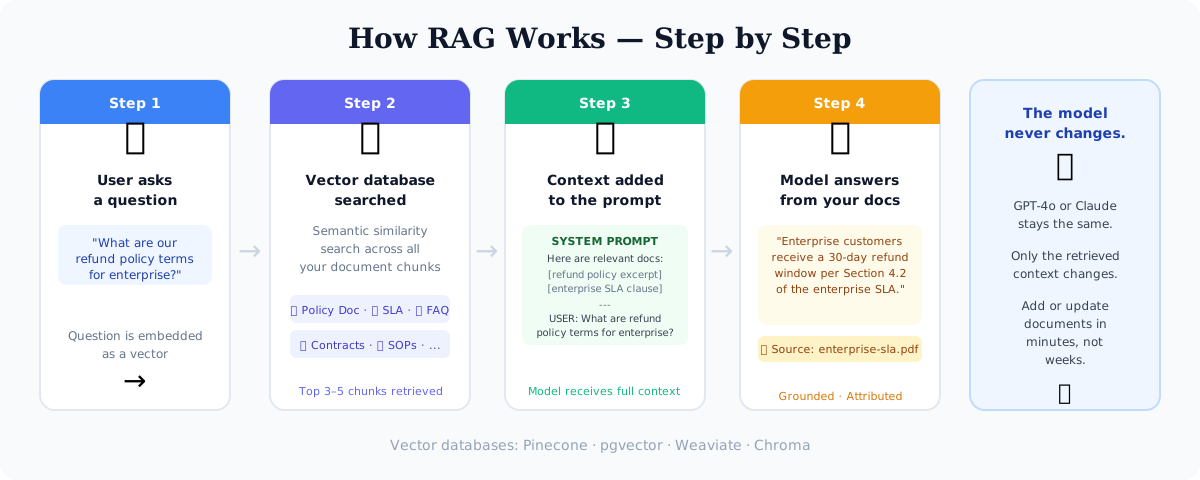
RAG stands for Retrieval-Augmented Generation. The name is technical, but the idea is simple: before the AI answers your question, it first searches a library of your documents, finds the relevant ones, and adds them as context to the prompt. The model then answers using both its own knowledge and the retrieved documents.
Think of it like this: instead of asking the AI a bare question and hoping it knows the answer, you're adding a step where it looks up the relevant information first — the way a good research assistant would. The model doesn't change. The documents don't change. You're just giving the model better context at query time.
How it works technically: Your documents are split into chunks and embedded as vectors (numerical representations of meaning) using an embedding model. These vectors are stored in a vector database (Pinecone, pgvector, Weaviate, Chroma). When a user asks a question, the question is also embedded, and the most semantically similar document chunks are retrieved from the vector database. Those chunks are inserted into the prompt alongside the question, and the model answers using both.
What RAG is good at: Answering questions about your specific documents, data, or knowledge base. Keeping answers grounded in your actual content — reducing hallucination. Supporting large, constantly-changing document sets (because you can add new documents without retraining). Providing citation and source attribution. Working with proprietary data without ever sending it to a third-party model for training.
What RAG struggles with: Learning a new writing style, tone, or output format. Tasks that require deeply internalised domain expertise rather than document retrieval. Cases where the right answer isn't anywhere in your document library. High-volume, low-latency applications where the retrieval step adds too much latency.
Fine-tuning explained in plain English
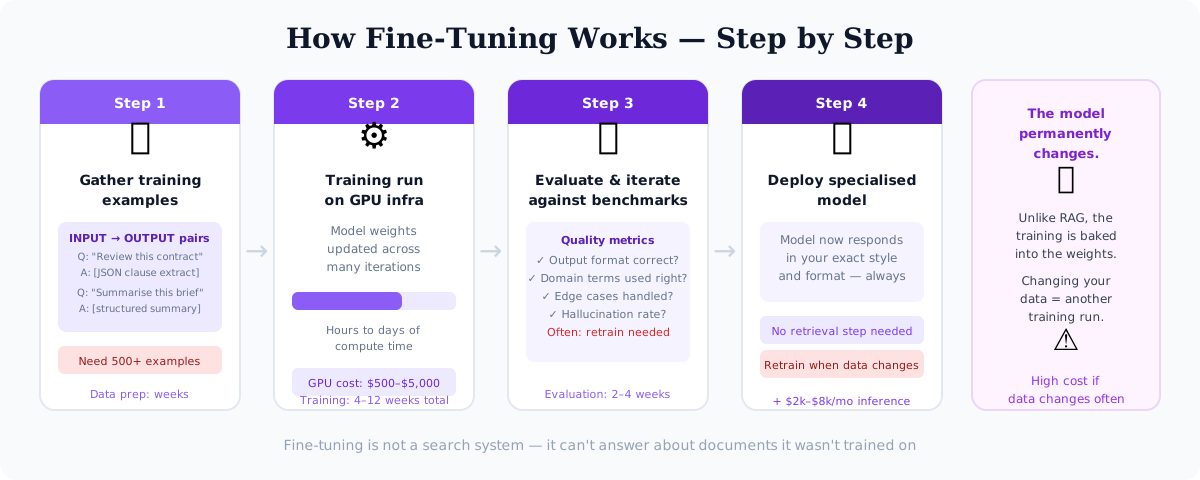
Fine-tuning is the process of taking an existing model and continuing to train it on your specific examples so that it internalises new patterns, styles, or domain knowledge. The model's weights change — it literally becomes a different (specialised) model.
The analogy: instead of giving an employee a reference manual to look up (RAG), you're putting them through a months-long training programme so they internalise the knowledge. After training, they don't need the manual — they've absorbed it. That's fine-tuning.
What fine-tuning is good at: Teaching the model a specific output format or style (e.g., always respond in JSON with these exact fields). Internalising specialised domain vocabulary that the base model doesn't know (medical billing codes, legal clause terminology, proprietary acronyms). Reducing prompt length and cost when the same context needs to be provided every time. Improving performance on a very narrow, well-defined task where you have thousands of examples.
What fine-tuning struggles with: Answering questions about documents the model wasn't trained on — fine-tuning is not a search system. Staying current when your data changes — you need to retrain or fine-tune again. Preventing hallucination — fine-tuned models still make things up. Small datasets — you need at minimum hundreds of examples, ideally thousands, for fine-tuning to outperform prompt engineering.
The 4-question decision framework
Most teams that pick the wrong approach do so because they're thinking about what's "smarter" rather than what their actual use case needs. These four questions cut through that.
Question 1: Is your primary goal answering questions about specific documents?
If yes: RAG. This is exactly what RAG is designed for. The model doesn't need to know the content upfront — it retrieves it at query time. Fine-tuning a model on documents gives you a model that "knows" the documents, but this approach breaks down as documents change, doesn't support attribution, and hallucinates more than RAG on content-specific questions.
Question 2: Is your primary goal changing how the model writes, formats, or responds?
If yes: fine-tuning (or advanced prompt engineering). If you need the model to always output JSON in a specific schema, respond in a particular industry tone, or follow a rigid format — that's style, not retrieval. RAG doesn't help you here. Fine-tuning or a well-crafted system prompt does.
Question 3: Does your data change frequently?
If yes: RAG. Adding a new document to a RAG system takes minutes — you chunk it, embed it, and add it to the vector database. Fine-tuning on updated data requires a new training run (hours to days, plus cost). If your knowledge base evolves weekly, RAG is the only operationally sustainable approach.
Question 4: Do you have 500+ high-quality training examples?
If no: don't fine-tune yet. Fine-tuning with insufficient data produces a model that's worse than the base model on edge cases and often overfits to the training set. Start with prompt engineering or RAG, accumulate real user interactions as training data, then fine-tune later when you have enough.
Real cost and timeline comparison
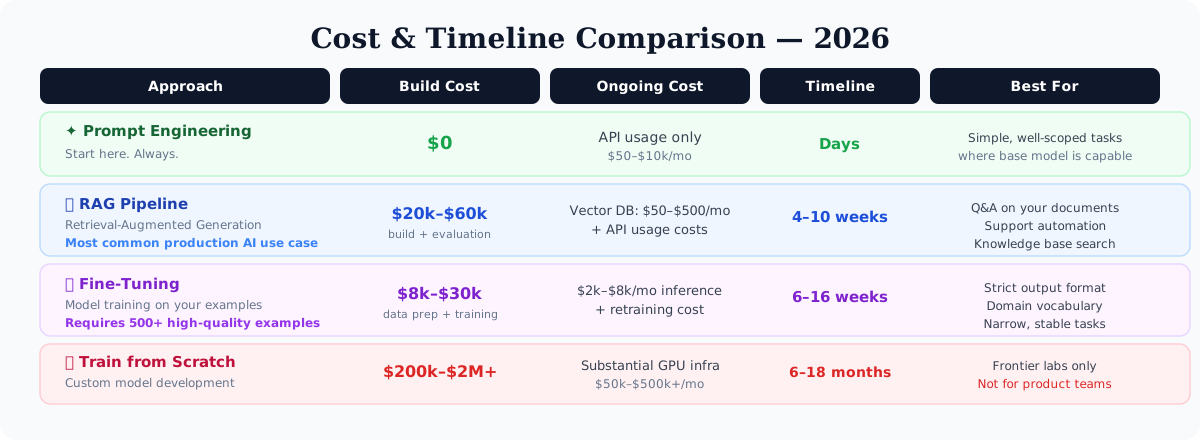
Prompt engineering only
Cost: $0 upfront. Ongoing: the API bill.
Timeline: Days to a working version.
Best for: Well-scoped tasks where the model's base capability + a well-crafted system prompt is sufficient. Most AI features start here and many never need to go further. Always try this first.
RAG pipeline
Cost: $20,000–$60,000 to build properly. Ongoing: vector database hosting ($50–$500/month) + API costs.
Timeline: 4–10 weeks for a production-quality system with evaluation, fallbacks, and monitoring.
Best for: Q&A over your documents, knowledge base search, document intelligence, support automation with sourced answers. The most common production AI use case.
Fine-tuning an existing model
Cost: $8,000–$30,000 for data preparation + training run. Ongoing: $2,000–$8,000/month for inference if self-hosted, or per-token if API-based.
Timeline: 6–16 weeks including data collection, cleaning, training, and evaluation.
Best for: Strict output format requirements, domain-specific terminology adoption, cost reduction through shorter prompts at high volume. Almost never the right first step.
Training from scratch / custom model
Cost: $200,000–$2,000,000+. Ongoing: substantial GPU infrastructure.
Timeline: 6–18 months.
Best for: Frontier labs and large enterprises with unique data moats. Not relevant for the vast majority of AI product teams.
The third option most teams overlook: prompt engineering
Before you build a RAG pipeline or start a fine-tuning project, spend two weeks writing and testing system prompts. The quality of the system prompt accounts for 60–80% of a well-running AI feature's output quality — and most teams underinvest here because it feels too simple.
A well-crafted system prompt specifies: the model's role and expertise, the output format in detail, constraints on what it should and shouldn't say, examples of good and bad outputs (few-shot examples embedded directly in the prompt), and how to handle edge cases and uncertainty.
Many teams that think they need RAG actually need better prompts. And many teams that think they need fine-tuning actually need RAG. The order matters: prompt engineering → RAG → fine-tuning. Each step is significantly more expensive, slower, and harder to maintain than the previous one. Don't skip ahead.
The right answer for most products
If you're building your first AI feature or an early AI MVP:
- Start with prompt engineering. It costs nothing and often gets you 80% of the way there.
- Add RAG if your product needs to answer questions about specific, changing documents.
- Consider fine-tuning only if you have a narrow, well-defined task, 500+ examples, and the prompt-engineered version isn't performing well enough.
- Avoid training from scratch entirely — it's not the right tool for a product team.
The most common expensive mistake we see: a team reads about fine-tuning, decides their AI product needs it because it "sounds more advanced," spends 3 months and $40,000 on a fine-tuning project, and ends up with a model that's only marginally better than the prompt-engineered version — and much harder to update.
Our AI application development team builds production RAG systems, fine-tuning pipelines, and everything in between. If you're not sure which approach fits your use case, a 15-minute call is enough to point you in the right direction. No commitment required. Book your call with Srijith here.
If you're also thinking about the full cost of building an AI product, see our guide to AI application development cost in 2026.
Krish N
Solutions Architect, Squash Apps